Top 3 City Spotlight
Asthma Capitals®: Top 3 Cities
The 2026 Asthma Capitals [3] top 3 cities have significant asthma burden. People who live in these areas face higher risk of having asthma, asthma emergencies, or even asthma-related deaths.
AAFA’s data analysis finds that these cities are the most challenging for people with asthma:
The social and environmental influences, risk factors, and policies affecting these cities are detailed below.
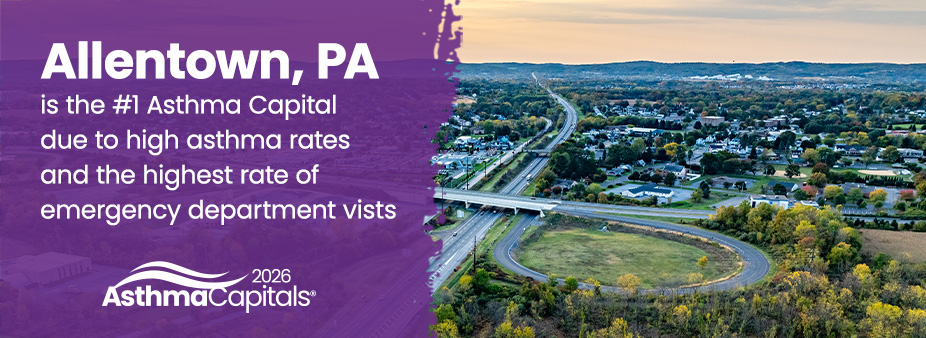
Allentown, Pennsylvania – #1 Asthma Capital in 2026
Allentown returns as the #1 Asthma Capitals in 2026. Allentown was previously the #1 Asthma Capital in 2021, 2023, and 2024, and since 2019, the city has landed in the top 10 of 100 of AAFA’s annual ranking.
Why does Allentown keep showing up at the top of AAFA’s Asthma Capitals? Among the 100 city areas we analyzed, Allentown has:
- The highest emergency department (ED) visits for asthma
- The 9th highest asthma prevalence (rates)
Asthma is a major health concern for families due to air pollution across the Lehigh Valley, where Allentown is located. The area received an F rating due to the number of high particle pollution days.1 Allentown’s location along the busy I-78 and Route 22 corridors exposes residents to heavy traffic pollution, while nearby industrial activity adds to the burden.
Indoor air quality is a concern as well. Nearly 40% of homes in Allentown were built in 1939 or earlier. Older homes often have poor indoor air quality due to combustion pollutants (fireplaces, poor ventilation for gas appliances), lack of modern filtration, mold and mildew, and old building materials like asbestos and lead paint.
Allentown has smoke-free laws in workplaces and publicly owned multi-unit housing. However, the area does not have smoke-free laws in restaurants, bars, or cars with minors, which can further put the population at risk of harm from tobacco products.
Community Action: AAFA’s HEAL Allentown Program
The Empowering Asthma Self-Management and Education (EASE) Allentown program provides self-management education, virtual home assessments, and resources to help older adults living with asthma improve their quality of life. With funding from AAFA, the Health Promotion Council of Southeastern Pennsylvania (HPC) developed the EASE program in collaboration with the Allentown Health Bureau.
Learn more about joining the EASE program. [7]
Climate and Policy Solutions
Pennsylvania Climate Emission Reduction (PACER) Program [8]
The PACER bill would establish a cap-and-invest program to set Pennsylvania’s carbon limit and invest in reducing electricity costs. The program aims to protect and create energy jobs, lower electricity costs for Pennsylvanians, and take tangible action to address climate change. Savings from the program will be allocated to grant programs to support projects that eliminate air pollution and invest in clean energy solutions. This bill was introduced in 2025 and has not passed the Pennsylvania General Assembly yet.
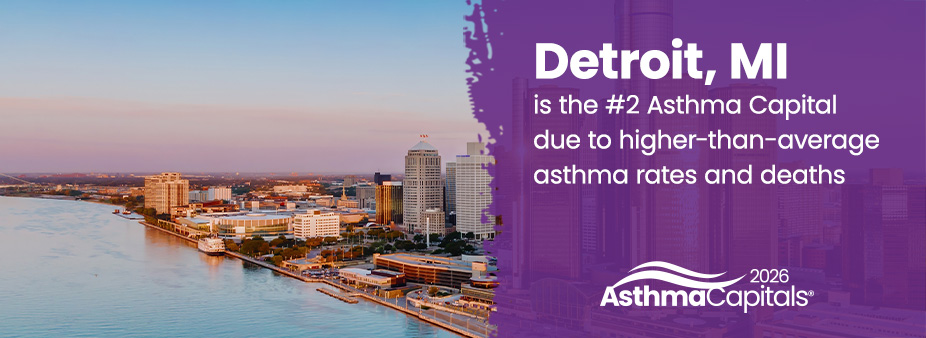
Detroit, Michigan – #2 Asthma Capital in 2026
Detroit is the #2 Asthma Capital in 2026, dropping down from #1 in 2025. For the past 10 years, the city has consistently landed near the top of AAFA’s annual ranking.
Why does Detroit keep ranking as a top Asthma Capital? Of all cities analyzed for the Asthma Capitals, Detroit has:
- The 2nd highest asthma prevalence (rates)
- Higher than average asthma deaths
Behind these numbers are important risk factors that make asthma harder to manage in Detroit:
- High poverty rates: Nearly 1 in 4 Detroit residents live below the poverty line. For families already struggling to afford housing, food, and utilities paying for medicines, doctor visits, and asthma-friendly products can be out of reach. Poverty may also increase exposure to poor indoor air quality, mold, pests, and other triggers that make asthma worse.
- Significant air pollution: Detroit is named as one of the most polluted cities in the country.1 Detroit’s air quality is impacted by 2 major sources – heavy vehicle traffic and industrial emissions. The city sits at the crossroads of multiple interstate highways, bringing constant exhaust exposure. It is also home to steel plants, refineries, and other factories that contribute particulate matter and ozone pollution. Together, these pollutants irritate airways, increase the risk of asthma attacks, and worsen long-term lung health.
Community Action: AAFA’s HEAL Detroit Program
AAFA’s HEAL Detroit program – led by the AAFA Michigan Chapter delivers a holistic asthma management intervention – delivers a holistic asthma management intervention. The program includes:
- Self-management education so people can better control their asthma
- Connections to asthma specialists and nutrition support
- Virtual home environmental assessments with certified community health workers
- Additional support like healthy food boxes, gym memberships, and Asthma & Allergy Friendly® Certified home products [9]
Now in its 4th year, the program has expanded to provide patient education addressing additional topics, such as managing asthma when air quality is poor and staying up to date on vaccines to help prevent asthma complications (other health issues) due to respiratory infections.
Detroit residents interested in joining the HEAL Detroit program can find more information on the AAFA Michigan Chapter website [10].
Protecting Progress in Detroit
Most participants in AAFA’s HEAL Detroit program report high social and financial barriers – 59% are on Medicaid, and 51% have household incomes below $25,000 a year. Within just 6 months of being in the program, HEAL Detroit participants reported measurable improvements in asthma control, daily functioning, and quality of life:
- Asthma control: The number of people with well-controlled asthma jumped from 31% at baseline to 41% at 6 months of being in the HEAL program.
- Attendance and activities: People had more days of being healthy and doing regular activities. Consistent work and school attendance improved. At 6 months, half (47%) of people in the program reported no missed work or school days, up from 35% at baseline.
- Less emergency care: People in the program had fewer or no ED or unplanned health care visits. At 6 months, ED or unplanned health care visits decreased by 33%.
These results show how targeted support for Detroit households are not only improving health outcomes today but also laying the groundwork for lasting community benefits.
But this progress is now at risk from the following actions:
- Approved Medicaid cuts from H.R. 1, the “One Big Beautiful Bill Act,” will lead to more uninsured people. Nearly half of children with asthma are on Medicaid. Reduced funding for Medicaid will also lead to longer wait times in EDs and potential hospital closures.
- CDC funding cuts or program closures would affect funding for the Michigan Department of Health & Human Services (MDHHS). CDC’s National Asthma Control Program (NACP) provides financial support for the MDHHS Asthma Program (Asthma Initiative of Michigan). This program improves access to medications and asthma devices (such as spacers), helps schools prepare for asthma emergencies, provides asthma care discharge instructions for ED patients, and connects individuals and families with certified asthma educators for home-based asthma case management. The NACP needs Congressional support for continued and expanded funding.
- Public and private funding for health equity initiatives has been cut or reduced, and this puts population health initiatives at risk of closing or ending.
- Environmental protection rollbacks – especially for air pollution – will expose Detroit residents to higher amounts of harmful pollutants.
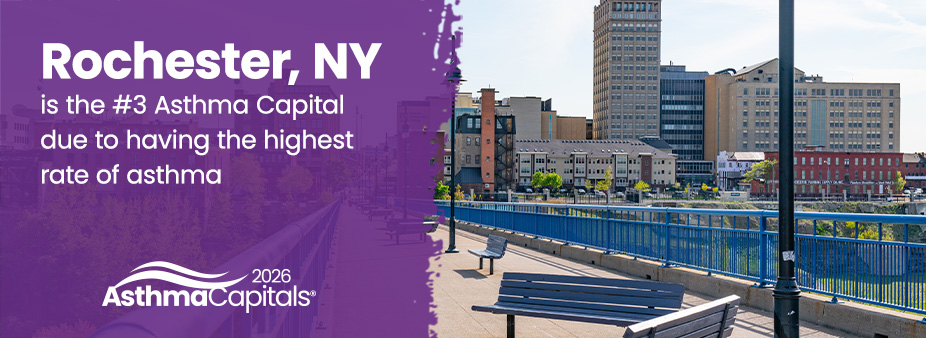
Rochester, New York – #3 Asthma Capital in 2026
Rochester has climbed steadily in the Asthma Capitals rankings, landing at #3 in 2026. The city has been in the top 20 of 100 since 2022 and landed at #2 in 2024 and 2025.
Why has Rochester rated so poorly as an Asthma Capital in the last few years?
Rochester has the highest asthma prevalence rate of all 100 cities we studied.
Risk factors that affect asthma rates in Rochester:
- Lack of access to specialists
- Air pollution: annual airborne particle pollution was high during the period analyzed
- Ranks #8 in the U.S. for pollen scores
Community Action: Supporting Kids with Asthma in Rochester Schools
Asthma weighs especially heavy on children in Rochester. Jill Halterman, MD, MPH, and her team at the University of Rochester Medical Center developed the School-Based Asthma Therapy (SBAT) program in partnership with Rochester City School District. SBAT ensures that students with asthma get their daily control medicines while at school, supervised by a nurse or health aide.2
The program has:
- Improved asthma symptoms and reduced school absences
- Lowered the need for emergency visits, especially when paired with telemedicine
- Served as a model for other districts nationwide, including New York City, Philadelphia, and Columbus
Building on its success, Rochester is testing new components with support from the National Institutes of Health.2 These include telemedicine support for children after emergency room visits, enhanced care for teens, and stronger connections with families.
Climate and Policy Solutions
Rochester’s asthma burden is shaped by air pollution, poor housing, and climate change. For example, recent environmental challenges, like smoke from wildfires drifting across upstate New York, add to the asthma burden in the city.
Climate Leadership and Community Protection Act of 2019 [11]
New York State is investing heavily in clean energy and pollution reduction through the Climate Leadership and Community Protection Act, one of the most ambitious climate laws in the country. Policymakers and local advocates are exploring how these funds could improve air quality in cities like Rochester, reduce exposure to wildfire smoke, and provide resources for communities most affected by asthma.
Additionally, policymakers discussed other state-level initiatives and bills last year.
NY HEAT (New York Home Energy Affordable Transition) Act [12]
This bill would help New York move away from old, expensive gas systems and switch to cleaner, more efficient heating.3 It would support local clean energy projects, create good-paying jobs, lower pollution, and improve air quality. These are all important for places like Rochester where many people have asthma.
Indoor Air Quality and Vaping in Schools Bill [13]
This bill would create an indoor air quality inspection, measurement and evaluation program, encouraging New York schools to install indoor air quality and vaping monitors. Using data from these monitors, districts will better understand the indoor air in their schools and develop plans to improve indoor air quality in buildings. If passed, bills like these could help address asthma by creating a healthier, cleaner, and more resilient environment in Rochester.
 [14]
[14]Join Our Online Support Community
Email: Display Name:AAFA is dedicated to improving the quality of life for people with asthma and allergic diseases. Our community is here for you 24/7. You can connect with others who understand what it is like to live with asthma and allergies. You're not alone. <!--
 -->
-->
About the Report
AAFA publishes the Asthma Capitals [3]® report to raise awareness about the nationwide impacts of asthma. The report analyzes asthma data across the United States and ranks cities by the most critical of health outcomes – asthma prevalence, emergency department visits due to asthma attacks, and asthma-related mortality. The outcomes are not weighted equally. The report also examines asthma risk factors that influence the outcomes.
AAFA only evaluates the top 100 populated places (based on metropolitan statistical areas or MSAs) in the contiguous (“lower 48”) states for this report. MSAs are cities and their surrounding areas (like suburbs and nearby rural areas). The report does not reflect:
- Cities and areas not in the top 100 list by population size
- Completely rural areas that are not located within a metropolitan statistical area
- Anchorage, Alaska and Honolulu, Hawaii due to lack of matching data with other cities, counties, states
Acknowledgements
The 2026 Asthma Capitals report is an independent research project of the Asthma and Allergy Foundation of America (AAFA) and made possible by support from Amgen, AstraZeneca, Chiesi, and Sanofi and Regeneron. AAFA also thanks Komodo Health and Pollen Sense, LLC for additional support for data used in this report. The views and opinions expressed in this report are those of the AAFA authors and do not necessarily reflect the policies or positions of the sponsors or other individuals, organizations, or companies.
Recommended Citation
Asthma and Allergy Foundation of America, (2026). 2026 Asthma Capitals®. Retrieved from asthmacapitals.org.
Closed
References
- American Lung Association. (2026). State of the Air 2026 Report. American Lung Association. https://www.lung.org/research/sota/city-rankings/msas/allentown-bethlehem-east-stroudsburg-pa-nj [16]
- Halterman, J. S., Tajon, R., Tremblay, P., Fagnano, M., Butz, A., Perry, T. T., & McConnochie, K. M. (2017). Development of School-Based Asthma Management Programs in Rochester, New York: Presented in Honor of Dr Robert Haggerty. Academic pediatrics, 17(6), 595–599. https://doi.org/10.1016/j.acap.2017.04.008 [17]
Related Content


 [20]
[20]