- Asthma & Allergy Foundation of America - https://aafa.org -

Eczema

Allergies

/ Allergies [1] / Allergy Symptoms [2] / Skin Allergies [3] / Eczema

Eczema

Around 18.9 million adults and 8 million children in the U.S. have eczema. This equals about 1 in 14 adults and 1 in 9 children.1,2 About 60% of people will develop eczema in their first year of life.3 Around 15 to 30% of children and 2 to 10% of adults have eczema at some point during their lifetime.4 Eczema can affect people of all races and ethnicities.

What Is Eczema?

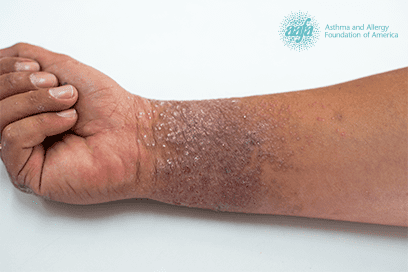
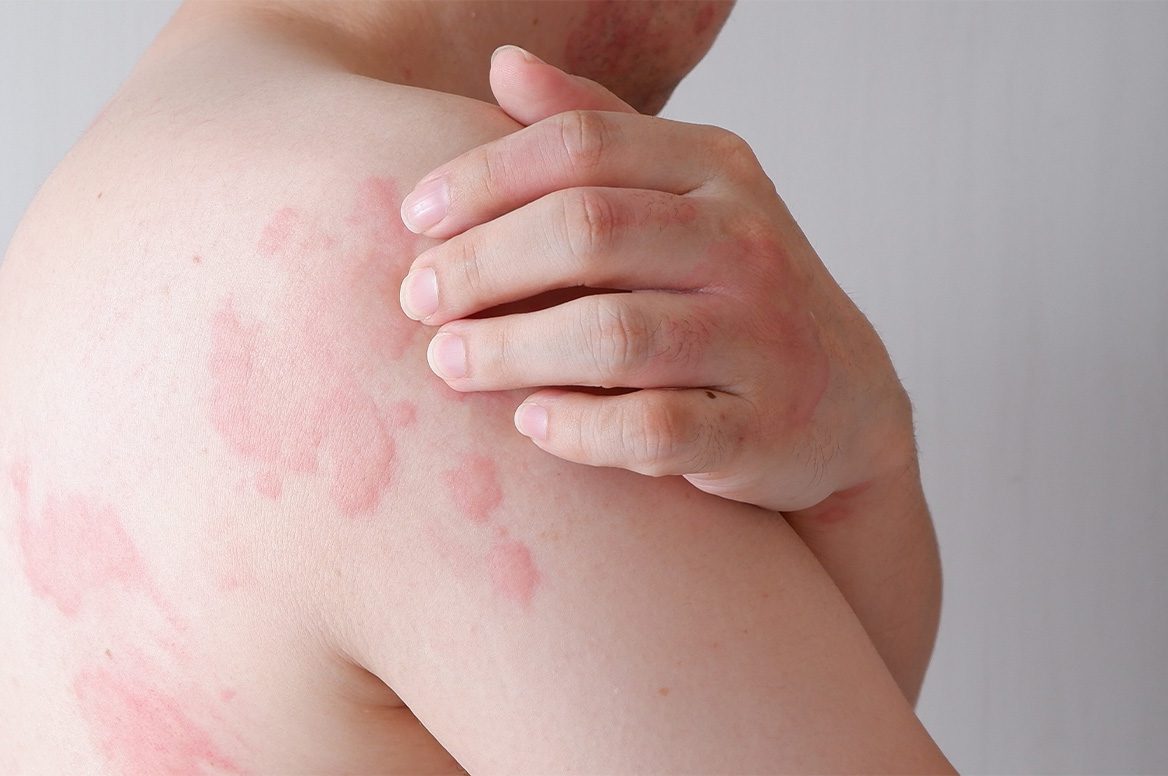
Eczema is a group of chronic skin conditions that cause your skin to become inflamed. It is not contagious. It can cause your skin to be dry, itchy, red, and irritated. You may also develop rashes, blisters, scaly patches, weeping skin, and infections. The affected skin may change color – often gray, purple or deeper brown on darker skin tones and red or pink on lighter skin tones. Over time, the rash may become thick and hard.

Eczema weakens the skin barrier, the barrier that helps your skin hold onto moisture and protects the body from outside irritants, infections, and allergens.

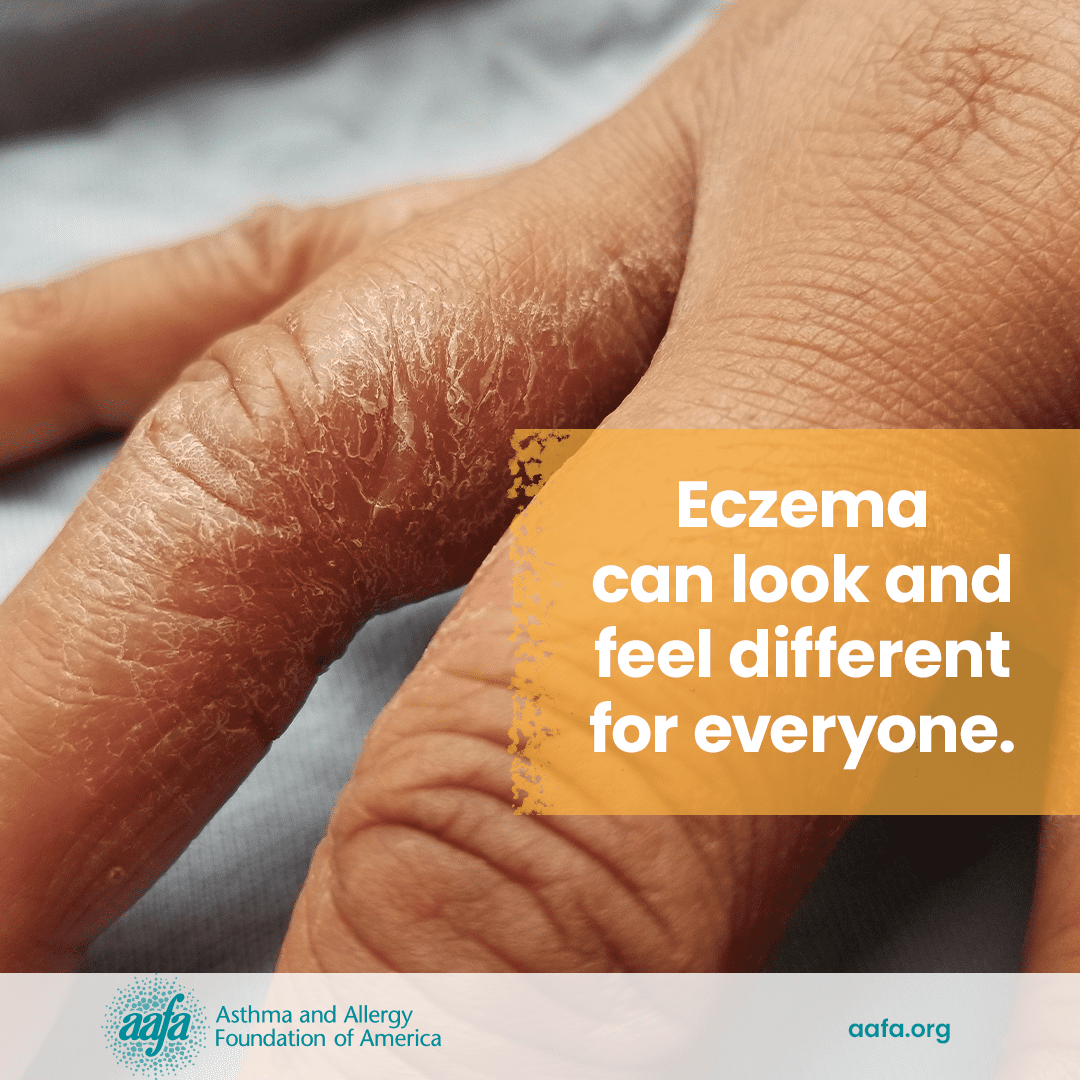
Closeups of 2 different hands showing the color difference of eczema.

What Are the Different Types of Eczema?

There are several types of eczema. Many are related to allergies.

Atopic dermatitis is the most common form of eczema. Allergens, irritants, chemicals, temperature, and emotions can trigger this type of eczema. Your skin gets dry and itchy, which can lead to rashes and scaly patches. Atopic dermatitis is more common in infants and young children but can occur at any age.

Contact dermatitis [4] is an allergic skin condition caused by irritants and allergies. You usually get a rash soon after an irritant or allergen touches your skin (such as nickel, poison ivy, and latex). This rash is often called allergic contact dermatitis.

Dyshidrotic eczema causes tiny, itchy blisters to appear on your hands or feet. This type of eczema can be painful and result in a burning feeling of the affected skin areas. It can be triggered by an allergy to items such as soaps, nickel, cobalt, sweat, and stress.

Hand eczema is often seen in people who get their hands wet, wash their hands a lot, or are exposed to chemicals often. This can include medical professionals, plumbers, contractors, chefs, and hair stylists. It can cause the skin on your hands to crack and bleed.

Neurodermatitis starts with a patch of itchy skin that becomes itchier as you scratch it. This itch can become intense when you sleep. People with atopic dermatitis, contact dermatitis, obsessive compulsive disorder, and anxiety disorders are more likely to have neurodermatitis.

Nummular eczema causes small, raised, round, itchy spots to appear on your skin. It can be caused by a skin injury like a bug bite or scratch, a skin infection, stress, and heat.

Seborrheic dermatitis is a type of eczema that usually affects your scalp.

Stasis dermatitis occurs in people who have poor blood flow and circulation. It is common on the ankles because poor blood flow usually affects the legs. The affected skin usually becomes discolored.

How Do Doctors Diagnose Eczema?

Primary care providers can diagnose and treat eczema. But they may also refer you to a dermatologist and/or an allergist. They will ask about your medical history, symptoms, and what you think might have caused them. They will also do a physical exam. They may also do tests, such as allergy testing or patch testing. Routine lab work is generally not recommended and can cost a lot.

Physical exam and review of medical history: During your appointment, the doctor will look at your rash and ask when it started and what was happening at that time. Where the rash shows up can depend on your age. Infants usually get rashes on their face, especially their cheeks, and on the outer parts of their arms and legs. Older kids and adults might get rashes in the folds of their arms and legs and sometimes on their hands and eyelids. The doctor might also ask if you did anything or were around something that could have caused the rash.

Allergy test (skin prick or blood IgE tests): Your doctor may test you for allergies through a test on your skin or with a blood sample [5]. For example, it is common for people with atopic dermatitis to be allergic to dust mites.

Patch test: Certain types of dermatitis might suggest contact allergy. If your doctor suspects contact dermatitis, they may ask you to wear skin patches containing small amounts of substances for two days. If you are allergic to the substance, you should develop a local itchy rash. The doctor will do a follow-up exam to check your reaction, usually 2 days after you remove the patch. Common examples of contact allergens include nickel, other metals, cosmetics, latex, and poison ivy.

What Are the Symptoms of Eczema?

Eczema can look and feel different for everyone. It usually shows up on your face, hands, arms, and legs, but it can show up on other parts of the body.

Common symptoms of eczema include:

  • Dry skin
  • Itchy skin
  • Scaly or rough patches on the skin
  • Inflamed or swollen skin
  • Oozing or crusty skin
  • Discolored skin – lighter skin tones may have red patches, while darker skin tones may look ashen white/gray, purple, or dark brown
  • Affected skin gets thicker

Children with persistent eczema, late onset, and more severe eczema have frequent or ongoing symptoms. Most children with eczema will outgrow eczema by the time they become an adult.
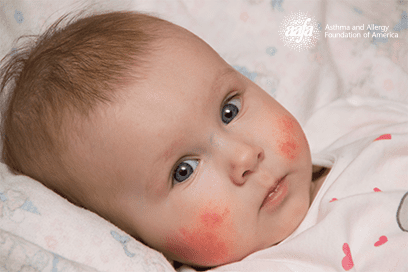
infant eczemaadult eczema

What Triggers Eczema?

Eczema is different for everyone, but knowing what irritates your eczema will help you manage the symptoms.

Common triggers of eczema include:

  • Dandelion icon
    Allergens (like dust mites [6]pet dander [7], certain foods, latex [8], and pollen [9])
  • Soap dispenser icon
    Soaps, lotions, detergents, and household cleaners
  • Nickel element icon
    Metals such as nickel (in jewelry, cellphones, belt buckles, etc.)

  • Stress, emotions, illness, and infections (such as staph skin infections)
  • perfumes and dyes
    Irritants (like fragrances, dyes, chemicals, and formaldehyde)

  • Changes in temperature (heat, cold, dry weather) and humidity

What Are the Treatments for Eczema?

Managing your eczema involves:

1. Avoiding triggers

Learn what triggers your eczema and do your best to avoid your triggers as much as possible.

2. Over-the-counter and prescription medicines

Treatments are available to help relieve and prevent symptoms for some types of eczema:

  • Lotions and barriers to moisturize dry skin and prevent loss of moisture (for example, petroleum jelly, lotions, creams, and ointments)
  • Hydrocortisone cream or ointment to reduce inflammation
  • Antihistamines to help manage allergies (do not typically help the itching from dry skin)
  • Prescription medicines to reduce inflammation, such as:
    • Oral or stronger corticosteroid creams and ointments
    • Topical calcineurin inhibitors (TCIs)
    • Biologics (such as Dupixent® and Adbry®)
  • Antibiotics (pills or creams) to treat skin infections
  • Phototherapy, the use of ultraviolet light under medical supervision

Treating eczema can help relieve pain and itching, prevent infections, and improve quality of life. Remember to talk with your doctor to help create a treatment and management plan that will work for you.

It’s important to see your doctor regularly to manage your eczema. Your doctor can check your treatment plan and make changes if needed.

3. Appropriate skincare routine

How you treat your skin can affect how well you can control your eczema. Follow these steps to take care of your skin and reduce inflammation and infection.

Bleach Baths

Everyone has bacteria on their skin. The most common is Staphylococcus aureus also known as “staph”. When you have eczema, your skin may get broken open from scratching, and this lets the bacteria get inside the top layers of skin and cause an infection.  To help clear up or prevent infections, your doctor may recommend “bleach baths”. This is an option for people with persistent or severe eczema, or who have a skin culture test positive for staph, or when other medical treatments have not worked. Bleach baths decrease the amount of bacteria on the skin. This procedure is safe to do. It involves adding a small amount of bleach to the bath water. It needs to be diluted so that the bleach doesn’t cause irritation.

How to do a bleach bath:

  • Fill tub with lukewarm water.
  • Add 1/4 cup of bleach to water.
  • Soak for 5-10 minutes.
  • Repeat 2-3 times per week.

Bleach baths can help reduce the severity of eczema in people prone to skin infections. 

Soak and Seal

A key step to taking care of eczema is to help your skin stay moisturized. You can do this by soaking it in water first, then sealing it with a barrier.

  • Take short showers or baths (about 5 to 10 minutes) in lukewarm water.
  • Don’t scrub your skin and avoid exfoliating products.
  • Use a cleanser instead of soap that is unscented and free of perfumes and dyes.
  • Pat your skin to dry off. Don’t rub it.
  • Use fragrance-free skin products without a lot of preservatives like unscented petroleum jelly, ointments, creams, and lotions. Be sure to use clean hands to apply products.

Wet Wrapping

In people with severe eczema, wet wrapping may be useful. After the soak and seal, you wrap your skin in damp gauze or clothing over the affected areas. This helps the skin stay moist for longer and helps rehydrate the skin.

How to do wet-wrapping for severe eczema:

  • Start with the soak and seal method. Do a bleach bath if recommended by your doctor. 
  • Seal the skin with prescribed skin ointments and creams. 
  • Wrap the affected skin areas with damp gauze or clothing (e.g. long socks, cotton gloves, leggings, etc.)
  • Cover the wet materials with a dry layer of clothing or wraps. 
  • Sleep with damp gauze over the affected areas of your skin. Warm up your blankets if needed as being wet may make you cold.

Stay Hydrated

Eczema causes moisture loss. Stay hydrated by drinking enough water during the day.

Your doctor can help you create an eczema management plan. Don’t lose hope – there are many treatments that can help manage symptoms and improve your quality of life.

Is Eczema Contagious?

You cannot catch eczema from someone else.

Medical Review: August 2024 by John James, MD

Closed
Drug Company Assistance Programs

The medicines covered by the programs below may change at any time. The following medicines are covered as of Jan. 24, 2025.


Company:

  • AstraZeneca

Medicines offered:

  • AIRSUPRA®

If you have commercial insurance: If you have employer-provided or individual private (commercial) insurance, you may be able to get AIRSUPRA for as low as $0 with the SUPRA Savings Card [10].

If you have government insurance: For people with Medicare Part D coverage, the average out-of-pocket cost is $89 per month. For people with Medicaid, the out-of-pocket costs range from $.99-$13 per month. Some states offer even lower copays or eliminate the copay altogether. If you have Medicare Part D and cannot afford AIRSUPRA, you may be eligible for the patient assistance program, AZ&Me [11].

If you have no insurance: If you do not have health insurance or your insurance does not cover AIRSUPRA, you will pay the amount determined by your pharmacy. You may also be eligible for the patient assistance program, AZ&Me [11].

Learn more on the Cost Assistance with AIRSUPRA [12] website or call 866-480-0030.


Company:

  • AstraZeneca

Medicines offered:

  • BEVESPI AEROSPHERE®
  • BREZTRI AEROSPHERE®
  • SYMBICORT®
  • FASENRA®
  • TEZSPIRE®

If you have commercial insurance, government insurance, or no insurance:

AstraZeneca US Patient Support offers various savings for several of their medicines. They offer copay savings cards and patient assistance programs depending on what type of insurance you have.

For more information, visit AZPatientSupport [13] or call 800-236-9933.

AstraZeneca has capped the cost of their inhalers to $35 if you have commercial or private insurance. Learn more about the price cap. [14]


Company:

  • AstraZeneca

Medicines offered:

  • TEZSPIRE®

If you have commercial insurance: The TEZSPIRE Together Co-Pay Program [15] can help may help you save regardless of income if you qualify. Get doses for as little as $0 and up to $100 off your in-office administration costs (pre-filled syringe only). Learn more on the TEZSPIRE Together Co-Pay Program [15] website or call 888-987-7473.

If you have government insurance: The TEZSPIRE Together Program [16], you may be able receive TEZSPIRE at no cost if you qualify. This includes people who:

  • Are uninsured
  • Have Medicare Part B with no supplemental insurance
  • Have a Medicare Advantage plan with an affordability gap
  • Have insurance that does not cover TEZSPIRE

For more information, call 888-987-7473.


Company:

  • Boehringer Ingelheim

Medicines offered:

  • Atrovent® HFA
  • Combivent® Respimat®
  • Spiriva® Respimat®
  • Stiolto® Respimat®
  • Striverdi® Respimat®

If you have commercial insurance or don’t have insurance: If you qualify, your cost will automatically be discounted when you buy these inhalers at participating retail pharmacies. If your cost is more than $35, download and use a savings card. Learn more at: InhalerOffer.com [17]

If you have government-funded insurance: If you use Medicare, Medicaid, CHIP, or TRICARE, visit the Boehinger Cares Patient Assistance Program [18] webpage or call 800-556-8317 to apply for assistance.

Boehringer Ingelheim has capped the cost of their inhalers to $35 if you have commercial or private insurance. Learn more about the price cap. [14]


Company:

  • Sanofi and Regeneron Pharmaceuticals, Inc.

Medicines offered:

  • DUPIXENT®

If you have commercial insurance: The Dupixent MyWay® Copay Card may help you lower the cost of your copay. Learn more on the Dupixent MyWay Copay Card website [19] or call 844-DUPIXENT (844-387-4936), option 1.

If you don't have insurance or your insurance doesn’t cover Dupixent: You can apply for the DUPIXENT MyWay Patient Assistance Program [20]. For more information or to sign up, call 844-DUPIXENT (844-387-4936), option 1.

If you have Medicare: At this time, there is not a savings program for Dupixent if you have Medicare. Call 844-DUPIXENT (844-387-4936), option 1 for more information.

If you have Medicaid: Your copay and coverage may vary depending on what state you live in. If you meet the criteria, you may also be able to get help from the DUPIXENT MyWay Patient Assistance Program [20]. For more information or to sign up, call 844-DUPIXENT (844-387-4936), option 1.


Medicines covered:

  • Epinephrine devices – all brands

Savings programs:


Company:

  • Genentech

Medicines offered:

  • Xolair®

If you have commercial insurance: Genentech offers a copay savings program for Xolair [22]. You may also be able to get help from an independent copay assistance foundation [23]. Pdf icon

If you have government insurance or don’t have insurance: You may be able to get help from an independent copay assistance foundation. Find programs. [23] Pdf icon


Company:

  • GSK (GlaxoSmithKline)

Medicines offered:

  • ARNUITY ELIPTA
  • ANORO ELLIPTA
  • BREO ELLIPTA
  • INCRUSE ELLIPTA
  • NUCALA®
  • SEREVENT®
  • TRELEGY®

If you have commercial insurance: You may be eligible for the GSK Copay Assistance Program [24].

If you have Medicare or no insurance: You may qualify for the GSK Patient Assistance Program [25]. This program can help you receive certain GSK prescription medicines and vaccines at no cost.

For more information, visit GSK Patient Assistance Program & Savings Offers [26] or call 888-825-5249.

GSK has capped the cost of their inhalers to $35 if you have commercial or private insurance. Learn more about the price cap. [14]


Company:

  • GSK (GlaxoSmithKline)

Medicines offered:

  • NUCALA®

If you have commercial insurance: If you have a commercial medical or prescription insurance plan, you may be able to take part on the NUCALA Copay Program [27]. If you are approved, the GSK Copay Program may help with your cost share for NUCALA and the your cost share for administration up to the total annual copay program maximums.

If you have government insurance or no insurance: You are not eligible for this program if you are covered by any federal or state prescription insurance program.

For more information, visit the NUCALA Copay Program [28] website or call 800-691-1939.


Company:

  • Organon

Medicines offered:

  • ASMANEX® HFA
  • ASMANEX® TWISTHALER®
  • DULERA®

If you have commercial insurance: If you qualify, you may be able to save with an ASMANEX Multiuse Savings Coupon [29].

If you qualify, you may pay as little as $15 per Dulera prescription [30] on each of up to 12 qualifying prescriptions. The maximum savings is $90 per prescription.

If you have government insurance or no insurance: At this time, there is no assistance program if you have Medicaid or Medicare.


Company:

  • Teva

Medicines Covered:

  • QVAR RediHaler®
  • CINQAIR®

Teva Cares Patient Assistance Program [31] provides certain Teva medicines at no cost if you live in the United States and meet specific insurance and income criteria. Learn more about program eligibility. [32]

If you do not meet the eligibility requirements for the Teva Cares Foundation Patient Assistance Programs, you may be eligible for help from other programs they offer.

For more information, visit the Teva Cares Foundation [33] website or call 888-838-2872.

Back to top [34]

Pharmacy Drug Savings Programs

Program Name:

Contact Information:

About the Program:

  • Blink Health finds the lowest price for the medicines you need. Find discounted prescription prices on more than 15,000 medicines.

Program Name:

Contact Information:

About the Program:

  • BlinkRx is a digital pharmacy service that carries certain medicines. They can provide the lowest prescription price while providing free home delivery.

Program Name:

Contact Information:

  • 855-268-2822

About the Program:

  • GoodRx is a free resource that lets you compare medicine prices and find discounts.

Looking for savings on asthma inhalers? See the GoodRx Savings Guide [40] for ways you may be able to save money on 25 asthma inhalers.


Program Name:

Contact Information:

  • 833-317-2937

About the Program:

  • The Kroger Health Savings Club is an annual membership program that entitles members to reduced prices on prescription drugs.

Program Name:

Contact Information:

About the Program:


Program Name:

Contact Information:

  • 888-331-1002

About the Program:

  • The SCBN Prescription Assistance program is for uninsured or underinsured people who cannot afford their prescribed medicines.
  • The program requires a membership fee to participate.

Program Name:

Contact Information:

  • Contact your local Walmart pharmacy

About the Program:

  • The Walmart low-cost Prescription Program includes up to a 30-day supply for $4 and a 90-day supply for $10 of some covered generic drugs at commonly prescribed dosages. Prices for some drugs covered by the program may vary by state.

Program Name:

Contact Information:

  • 877-296-4673

About the Program:

  • Prescription Hope provides access to brand-name medicines for only $60 a month per medication through their medication access service. Learn about program eligibility [48].

Back to top [34]

Nonprofit Copay and Premium Assistance Programs

Organization:

Contact Information:

About the Program:

  • AcariaHealth provides specialty pharmacy services for people living with complex and chronic health conditions. Their Copay Assistance Support Team will research and apply to qualifying patient assistance programs on behalf of the patient. Learn about the program [51].

Organization:

Contact Information:

  • 800-366-7741

About the Program:

  • Accessia Health provides financial help to pay for copays, health insurance premiums, travel costs, and other medical expenses. Learn about program eligibility [53].

Organization:

Contact Information:

  • 877-968-7233

About the Program:

  • Good Days provides financial support for people who cannot afford the treatment they urgently need.
  • Copay, travel, premium, and diagnostic testing assistance may be available.
  • Learn about eligibility criteria [55].

Organization:

Contact Information:

  • 980-859-3483
  • info@harborpath.org

About the Program:


Organization:

Contact Information:

About the Program:

  • HealthWell Foundation provide financial assistance to help with prescription copays, travel costs, behavioral health services, health insurance premiums, deductibles, and copays. Please note that diseases covered may change from time to time.

Organization:

Contact Information:

  • 866-316-7263

About the Program:

  • The PAN Foundation offers financial help for out-of-pocket medicine costs including copays, health insurance premiums, and transportation costs related to medical care. Learn about program eligibility [61]. Please note that diseases covered may change from time to time.

Organization:

Contact Information:

  • 866-512-3861

About the Program:

  • PAF’s Co-Pay Relief (CPR) program provides direct financial help to qualified people with co-payments, co-insurance or cost-sharing associated with prescription drugs through funds for specific disease states. Learn about program eligibility [63]. Please note that diseases covered may change from time to time.

Organization:

Contact Information:

  •  800-769-3880

About the Program:


Organization:

Contact Information:

  • 855-845-3663

About the Program:

  • TAF helps people and families by providing them with financial help for their copays, coinsurance, premiums, deductibles, and other health-related expenses.


Back to top [34]

Patient Assistance Tools and Databases

Tool:

Contact Information:

  • 800-794-6559

More Information:

  • BenefitsCheckUp® is a free service of the National Council on Aging (NCOA). It is an online tool to connect older adults and people with disabilities to benefit programs such as health care, medicine, food, utilities, and more.

Tool:

Contact Information:

About the Program:

  • Dispensary of Hope provides medicine to communities, free of cost. They are a charitable medication distributor dedicated to providing pharmacies and clinics with reliable access to medication that was generously donated by pharmaceutical manufacturers. Find a dispensing site near you, here. [70]

Tool:

Contact Information:

  • 800-503-6897
  • info@needymeds.org

More Information:

  • A national nonprofit that connects people to programs that may help them afford their medicines and other health care costs.

Tool:

Contact Information:

  • 571-350-8643

More Information:

  • PhRMA’s Medicine Assistance Tool (MAT) is a search engine for many patient assistance resources offered by drug makers.

Tool:

Contact Information:

More Information:


Tool:

Contact Information:

More Information:

  • SingleCare works with pharmacies on discounts on prescriptions. Look up prescriptions to find the lowest prices in your area.

Tool:

Contact Information:

  • 800-719-5147
  • rxsavingsfinder@rxsense.com

About the Program:

  • Walgreens Rx Savings Finder can help you find prescription discount cards that can help you find the lowest price on a medicine at Walgreens.

Back to top [34]

State Drug Assistance Programs

Organization:

  • Extra Help [79] – Social Security Administration

Contact Information:

  • 800-772-1213
  • (TTY 800-325-0778)

More Information:

  • The Extra Help program helps people with limited income and resources lower or cut Medicare Part D costs.

Organization:

Contact Information:

  • 877-839-2675
  • info@shiphealth.org

More Information:

  • Free insurance counseling and help to Medicare-eligible people, their families, and caregivers.

Organization:

Contact Information:

  • Contact your local county office.

More Information:

  • CalAIM offers people on Medi-Cal access to services that address ​physical, behavioral, developmental, dental, and long-term care needs.

Organization:

More Information:


Organization:

More Information:

  • Learn more about pharmaceutical companies that offer programs to help pay for prescriptions for people with a Medicare Drug Plan (Part D).

Back to top [34]

Community Resources

American Sleep Apnea Association [84]: Assists people with sleep apnea who cannot afford their CPAP mask supplies through the CPAP Assistance Program.

Friends of Man [85]: Receives applications for mobility equipment, prosthetics, home modifications, medical equipment, hearing aids, basic needs and much more. The referral must be made by a professional. This includes caseworkers, case managers, health care workers, social workers, school counselors, teachers, and clergy.

FoodFinder [86]: A map of food pantries across the United States. Search your ZIP code to learn about free food assistance programs near you.

FundFinder [87]: Helps you find financial assistance from charitable foundations.

Inspira Financial [88]: Funds in a health savings account (HSA) or a health care flexible spending account (FSA) can be used for eligible medical expenses.

Society of St. Vincent de Paul [89]: A national non-profit that provides local assistance and services.

United Way 211 [90]: The most comprehensive source of information about local resources and services in the country.

Back to top [34]

AAFA Regional Chapters

The AAFA New England Chapter [91] has more information on drug assistance for Massachusetts residents.

The AAFA Michigan Chapter [92] has more information on drug assistance for Michigan residents, including the Jared Williams Medication Fund (JWMF).