Asthma
Signs of Controlled and Uncontrolled Asthma
Understanding what well-controlled or “healthy” asthma looks like makes it easier to recognize when your asthma needs more attention. Feeling “okay” is not the same as having your asthma under control. You do not have to let difficult-to-manage asthma define or limit your life. You can be in control of your asthma!
When you have asthma [2], it’s important to know what is happening in your airways, common asthma symptoms, when to use your asthma medicines, or when to get emergency help.
On this page:
Controlling Asthma Prevents Medical Emergencies [3]
Asthma Action Plan [4]
Asthma Zones/Categories [5]
- Signs of Controlled Asthma: Green/Go Zone [6]
- Early Warning Signs of Asthma: Yellow/Warning Zone [7]
- Signs of Asthma: Yellow/Caution Zone [8]
- Danger Signs of Asthma: Red Zone [9]
How to Know If You Have Uncontrolled Asthma [10]
Preparing for Your Doctor’s Visit for Asthma [11]
Controlling and Preventing Asthma Keeps You Healthy
Asthma causes almost 1 million emergency room visits each year.1 Asthma is a serious chronic (long-term) condition that can change over time. Asthma causes airway inflammation that makes it hard to breathe. An asthma episode or attack can happen at any time. Mild symptoms may only last a few minutes, while more severe asthma symptoms can last hours or days.2 A severe asthma episode can cause death.
Asthma Action Plan
If you have asthma, work with your doctor to make an Asthma Action Plan. An Asthma Action Plan is a document that tells you how to manage your asthma according to your symptoms.3
Talk with your doctor about your symptoms and steps to manage them. If you do not have an Asthma Action Plan, you can download and email AAFA’s Asthma Action Plan [12] (available in English [13] and Spanish [14]) to your doctor or print a copy for your doctor to fill out.
Take your asthma medicines as directed on your Asthma Action Plan and always take your quick-relief medicines at the first sign of symptoms.
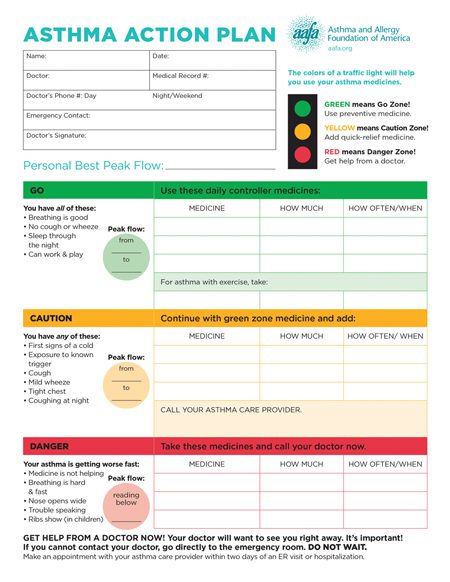
Asthma Action Plan
Everyone with asthma should have an Asthma Action Plan. This plan provides information and instructions on how you to manage your asthma. Work with your doctor to create an Asthma Action Plan.

Pregnancy and Lactation Asthma Action Plan
Complications from asthma are possible, but keeping asthma well-controlled during pregnancy may help reduce the chance of complications. A Pregnancy and Lactation Asthma Action Plan can help manage asthma.
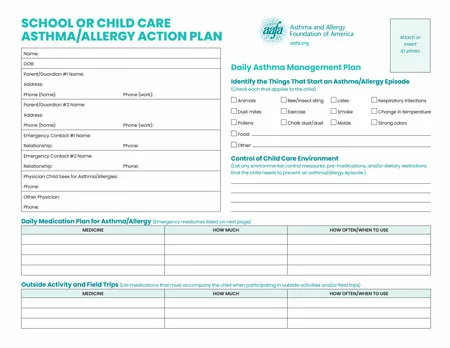
School or Child Care Asthma/Allergy Action Plan
Millions of children in the U.S. have asthma and/or allergies. The school or child care asthma/allergy action plan can be provided to a child’s school or child care center to help manage asthma and allergies in the classroom.
The Asthma Zones Concept
Asthma symptoms are divided into asthma zones. These zones use the colors of a traffic light to help you know which zone you are in and when to use your asthma medicines or get emergency help.2 The Asthma Action Plan is divided into three zones:
- Green – Go
- Yellow – Warning/Caution
- Red – Danger
These zones are based on symptoms.2 Your doctor will outline what medicines and steps to take for each zone. Some people also use a peak flow meter [15] (PFM) to assess their asthma. Peak flow ranges can be noted on the Asthma Action Plan.
If you are pregnant, knowing pregnancy-specific symptoms and your asthma zones can improve the health of you and your baby.
Talk with your doctor about what it means to have asthma under control and what else can be done to help you feel your best. If asthma gets in the way of your life or daily activities, ask for more help. Do not let your asthma control you. Ask for a referral to an asthma specialist to take a positive step toward better health and lifestyle.
Signs of Controlled Asthma: Green Zone
Green means Go Zone! You are in the Green/Go Zone if you have all of these:
- Breathing is good
- No cough or wheeze
- No chest tightness or pain
- Can sleep through the night
- Can work and play
- Peak flow readings are 80 to 100% of your personal best peak flow number
- If you are pregnant, good fetal movements are also a sign that you are in the Green/Go Zone
Action: Enjoy life to the fullest. Avoid your asthma triggers. Take your daily control or preventive medicines as directed (if prescribed).
If exercise is an asthma trigger, your Asthma Action Plan may have you take quick-relief medicine before you exercise to prevent asthma symptoms before you begin (sometimes referred to as “pre-treatment”). This will be listed on the Green/Go Zone of the plan.
When you are in the Green/Go Zone, your asthma is well-controlled.
Early Warning Signs of Asthma: Yellow Zone
Sometimes you may have early warning signs that an asthma episode is coming. You may have these signs before you start to have more obvious asthma symptoms. It is important that you are able to recognize early asthma warning signs and triggers. Identifying warning signs and taking steps to prevent asthma episodes can help keep asthma well-controlled. Early warning signs may be different for each person, but some common warning signs can include:
- Increased mucus/sputum production
- Runny/stuffy/congested nose
- Itchy neck or chin
- Feeling tired, weak, or lack of energy
- Raised shoulders, slouching
Your doctor can help you identify your early warning signs. When you have early warning signs, treat this as if you are in the Yellow/Caution Zone.
Action: Take your quick-relief asthma medicines as soon as you start to have early warning signs. Remove or avoid what might be triggering your asthma. (For example, if someone is smoking near you, try to leave the room/building if possible.)
Signs of Asthma: Yellow Zone
Yellow means Caution Zone! You are in the Yellow/Caution Zone when you have asthma signs or symptoms. Signs and symptoms that your asthma is getting worse include:
- Shortness of breath
- Cough
- Wheezing
- Chest tightness or pain
- Waking at night due to asthma symptoms
- Having any signs or symptoms after an exposure to a known trigger [16]
- Having breathing difficulty when sick with a cold or respiratory illness [17]
- Peak flow readings are 50 to 80% of your personal best peak flow number
- If you are pregnant, reduced fetal movements are also a sign that you are in the Yellow/Caution Zone
Action: Take your asthma medicines as listed on your Asthma Action Plan at the first sign of symptoms when you are in the Yellow/Caution Zone. This may be one quick-relief medicine (like albuterol), a quick-relief medicine and controller taken one right after each other, or a combination inhaler. Avoid or remove your asthma trigger. Monitor your symptoms until they improve.
If your quick-relief medicines don’t help and your symptoms do not improve, call your doctor.
If you are in the Yellow/Caution Zone two or more times per week, it is a sign your asthma is not controlled and you may need to contact your health care provider (doctor).
Danger Signs of Asthma: Red Zone
Red means Danger Zone! If you are in the Red/Danger Zone, take your quick-relief medicines and repeat as directed. If your breathing does not improve quickly, get emergency help. Severe asthma episodes can be life-threatening.
Signs and symptoms of an asthma emergency that need urgent medical care:
- Asthma is getting worse quickly
- Asthma quick-relief medicines are not helping
- Chest tightness or pain is getting worse
- Severe shortness of breath
- Lots of coughing
- Breathing is faster or slower than normal
- Breathing may be hard or shallow
- Trouble walking or talking due to shortness of breath
- Chest retractions (skin sucks in between or around the neck, chest plate, and/or rib bones when inhaling; this is rare in adults)
- Ribs or stomach moving in and out deeply and rapidly
- Expanded chest that does not deflate when you exhale
- Shoulders hunched over (“posturing”)
- Cyanosis, a tissue color change on mucus membranes (tongue, lips, and around the eyes) and fingertips or nail beds – the color appears grayish or whitish on darker skin tones and bluish on lighter skin tones
- Peak flow readings are below 50% of your personal best peak flow number
If you are pregnant, the following are also signs and symptoms of an asthma emergency that need urgent medical care:
- Headache
- Vomiting
- Vaginal bleeding
Infants, toddlers, and children may have different asthma emergency signs and symptoms than adults. Signs and symptoms of a severe asthma episode in infants, toddlers, and children:
- Infants with asthma who fail to respond to or recognize parents
- Nasal flaring – nostrils open wide/flare (may be rare in adults)
- Working harder to breathe (nasal flaring, skin is sucking in around and between ribs or above the sternum, or exaggerated belly movement or belly breathing)
- Cyanosis, a tissue color change on mucus membranes (tongue, lips, and around the eyes) and fingertips or nail beds – the color appears grayish or whitish on darker skin tones and bluish on lighter skin tones
- Infants with asthma in respiratory distress may have bobbing head, grunting, floppy body, or be irritable, agitated, cranky, and/or lethargic (sluggish)
For more information about emergency asthma signs and symptoms and how they differ between adults and children please visit https://aafa.org/asthma/living-with-asthma/ [18].
Action: Red/Danger Zone symptoms are a medical emergency. Take your quick-relief medicines right away as directed on your Asthma Action Plan and then get immediate medical attention. Call 911 or go directly to the emergency room.
Follow up with your doctor within two days of an emergency visit or hospital stay.
Signs of Uncontrolled Asthma
It is important that you do not ignore or underestimate your asthma symptoms and their severity.
A good way to know if your asthma is not well-controlled is by answering these questions:
- Do you have asthma symptoms more than two times a week?
- Do you take your quick-relief medicine more than two times a week?
- Do you wake up from asthma more than two times a month?
- Do you use oral or injectable corticosteroids more than two times a year? This includes medicines such as prednisone, prednisolone, Orapred®, Prelone®, Medrol, or Decadron.
- In the past year, have you been to the emergency department or urgent care for asthma symptoms?
- Over the past month, have you had to slow down, change, or reduce your daily activities due to asthma symptoms?
If you answer “yes” to any of these questions, talk with your doctor about your asthma control.
If your asthma is not well-controlled, your daily activities may be limited. You may miss work or school. You may increase your chances of having additional health problems from a respiratory infection. And you may be at greater risk for going to the emergency department, staying in the hospital, or even dying from asthma.
Oral (or injectable) corticosteroids [19] can provide fast and affordable treatment for severe asthma episodes. Feeling better after taking these drugs does not mean your asthma is under control again. Overuse of oral or injectable corticosteroids has become normalized and is now a significant barrier to improving asthma care. These drugs can cause significant side effects and harm. There are safer, better treatments to manage asthma.2
Preparing for Your Doctor’s Visit for Asthma:
Keep track of your:
- asthma symptoms,
- inhaler use,
- oral corticosteroids use, and
- visits to the emergency department or urgent care for your asthma.
Share this information with your doctor at every visit. Review your asthma action plan with your doctor. If you are prescribed a new type of inhaler, ask your doctor, nurse, or pharmacist to show you how to use it. Misuse of inhalers is a common reason why asthma may not be under control.
Editorial review: Melanie Carver, AAFA Chief Mission Officer
Closed
References
- US Centers for Disease Control and Prevention. (2023, May 10). Most Recent National Asthma Data. Retrieved March 16, 2026, from: https://www.cdc.gov/asthma/most_recent_national_asthma_data.htm [20]
- Goldin, J. and Cataletto, M. E. (2024, May 3). Asthma. In StatPearls. StatPearls Publishing. Retrieved March 16, 2026, from: https://www.ncbi.nlm.nih.gov/books/NBK430901/ [21]
- Global Initiative for Asthma. (2025, November 15). Global Strategy for Asthma Management and Prevention. Retrieved March 16, 2026, from: https://ginasthma.org/2025-gina-strategy-report/ [22]
 [23]
[23]Join Our Online Support Community
Email: Display Name:AAFA is dedicated to improving the quality of life for people with asthma and allergic diseases. Our community is here for you 24/7. You can connect with others who understand what it is like to live with asthma and allergies. You're not alone. <!--
 -->
-->
 [24]
[24]Related Content

 [26]
[26]