Asthma
Respiratory Syncytial Virus (RSV)
RSV usually causes mild symptoms. Most people get better in a week or two. But RSV can be serious, especially for infants, older adults, and people who are immunocompromised. Typically, the RSV season in the U.S. starts in the fall and peaks in the winter months, but the timing and severity of the RSV season can vary from year to year.
In children, this infection leads to millions of hospital stays each year, much like the flu. In adults, RSV can cause severe respiratory illness that can make underlying conditions such as chronic obstructive pulmonary disease (COPD) and heart failure worse.2
What Are the Symptoms of RSV?
It can take as long as 4 to 6 days after contact with RSV before someone has symptoms. Symptoms include:
- Runny nose
- Stuffy nose
- Eating less or not interested in eating
- Coughing
- Sneezing
- Red, inflamed eyes (conjunctivitis)
- Fever
- Wheezing (a whistling sound when breathing)
Symptoms in very young infants may be different. They can include:
- Being irritable or cranky (fussiness)
- Eating or drinking less or not interested in eating
- Decreased activity and poor responsiveness
- Trouble breathing (for example, cough, shortness of breath, wheezing, and respiratory distress)
- Faster breathing than usual
- Pauses in breathing that last more than 10 seconds
Call your child’s doctor right away if your child is having trouble breathing, not drinking enough fluids, not responding well, and/or their symptoms are getting worse.
If you or your child have any of the above symptoms, ask your doctor to test for COVID-19, flu, and RSV. It is possible to have any of these illnesses at the same time.
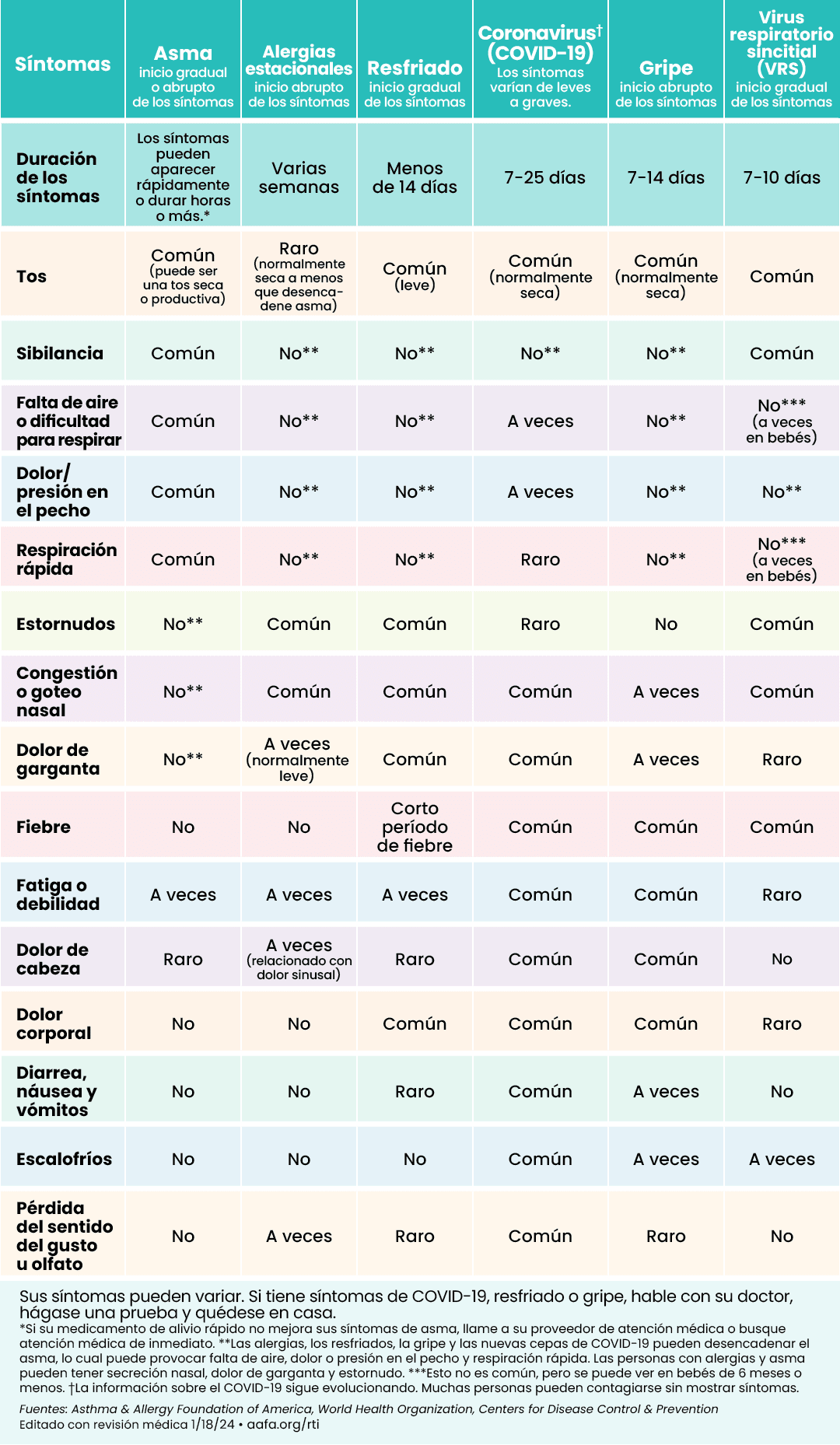
RSV may have symptoms similar to other respiratory illnesses, asthma, and allergies. Our chart below lists the different symptoms for RSV, the flu [4], COVID-19 [5], the common cold (caused by other viruses), asthma [1], and seasonal allergies [6].
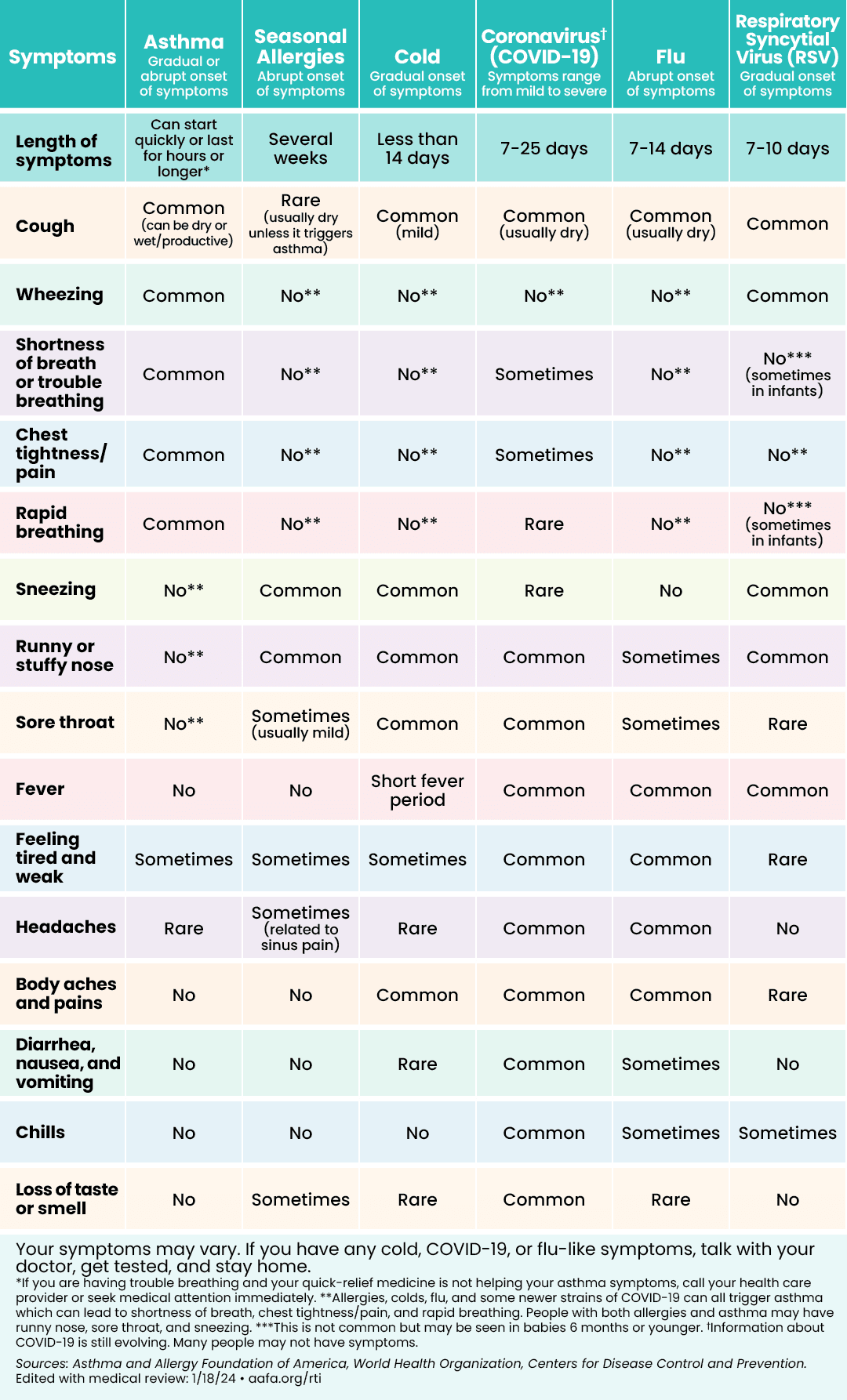
[7] | [8] |
Click to see larger image [7] (English) | Click to see larger image [8] (Spanish) |
How Does RSV Spread?
RSV spreads when people talk, laugh, cough, and sneeze. The virus droplets get into the air, and then you breathe them in. The droplets can also land on surfaces, like a doorknob or toys. You can catch the infection by touching the surface with the virus on it and then touching your face. The virus can live on hard surfaces, such as a table or crib rail, for many hours.
You can also get RSV from direct contact, like kissing someone with RSV. Children often come in contact with RSV at day care centers or in schools.
People of any age can get RSV, but it typically affects infants and toddlers. If you have a certain medical condition, the infection may be more severe.
Who Is at High Risk From RSV?
Adults who have the highest risk of severe illness and complications (serious health problems) from RSV infection include:
- Older adults, especially people 75 and older
- Adults with chronic heart or lung disease, such as asthma, COPD, heart failure, cystic fibrosis, or congenital heart disease
- Adults with weakened immune systems or immune deficiencies
- Adults living at high altitudes (8,500 feet or 2,500 meters or higher)
Infants and young children are also at high risk. Children at greatest risk for severe illness from RSV include:
- Premature infants
- Very young infants, especially ages 6 months and younger
- Children younger than 2 years old with chronic lung disease (like asthma or cystic fibrosis) or heart disease (present from birth or congenital heart disease)
- Children with neuromuscular disorders – this includes children who have trouble swallowing or clearing mucus
- Children with Down syndrome
Can RSV Cause or Affect Asthma?
Like the flu, RSV is a lung infection that can trigger asthma. You may not feel or see symptoms of RSV the first 2 days you are sick. By day 3, you may start to feel congested, have a runny nose, fever, or may start to cough, wheeze, and have trouble breathing. People with asthma may have more severe asthma symptoms when they have RSV.
If you or your child have asthma and get sick with RSV, be sure to follow your Asthma Action Plan [9]. Know asthma warning signs and symptoms. Call your health care provider if you or your child have trouble breathing, wheezing, a cough that gets worse, or symptoms that don’t get better or get worse.
There is a link between RSV infection in young children and the chances of developing asthma later in childhood.
RSV is the leading cause of hospital stays in young children and infants. Babies who get sick with RSV are more likely to have asthma later in childhood.3
What Is the Treatment for RSV?
If you have asthma, contact your doctor right away if you have symptoms of RSV. If your infant has RSV symptoms – whether they have asthma or not – contact their doctor.
Most RSV infections will go away on their own in about 7 to 10 days. RSV is caused by a virus, so antibiotics will not help. Talk with your doctor about taking over-the-counter medicines to help with symptoms, like pain relievers or cough and cold medicine. Be sure to talk with your doctor about how to take these medicines appropriately. Ask about nasal suction and lubrication – such as a nasal saline spray, mist, or drops – which may help ease congestion. Drink plenty of fluids and rest. Limit your time around other people to prevent spreading RSV.
Are There Vaccines and Treatments for RSV?
An RSV vaccine is available for infants and babies, pregnant people, and some older adults.
Talk with your doctor about the RSV vaccine if you:
- Are an adult 75 years of age and older
- Are an adult 60 to 74 years and older AND at an increased risk of RSV disease (see risk factors in the section, “Who Is at High Risk from RSV?”)
- Live in a nursing home or long-term care facility
- Are 32 to 36 weeks pregnant during RSV season (usually September through January)
The vaccine can help prevent lower respiratory tract disease that is caused by the RSV virus. It is a one-time dose vaccine and can be given at the same time as other vaccines.
There are also prescription medicines that provide protection against RSV for certain infants and young children, especially against severe illness. They are monoclonal antibody shots. They have proteins that stimulate your child’s immune system to fight RSV.
Nirsevimab (brand name Beyfortus) is recommended for:
- All infants younger than 8 months born during RSV season or entering their first RSV season. (If you got the RSV vaccine while you were pregnant, your infant may not need nirsevimab if they are younger than 8 months and were born 14 or more days after you got RSV vaccine.)
- Some children aged 8 through 19 months who are at increased risk for severe RSV disease and entering their second RSV season:
- Children who have a chronic lung disease because they were born prematurely
- Children who are severely immunocompromised
- Children with cystic fibrosis who have severe illness
- American Indian and Alaskan Native children
Palivizumab (brand name Synagis) is only for certain infants and children under 24 months old who are at high risk. This can include:
- Infants born prematurely (less than 29 weeks)
- Premature infants with chronic lung disease
- People with congenital heart disease (present from birth)
Palivizumab must be given once a month during RSV season. Dosing is based on your infant’s weight. Talk with your doctor about the most appropriate use of this treatment.
Talk with your doctor about which RSV prevention method is right for you and your child.
How Else Can I Protect Myself and Others From RSV?
Here are other steps to help protect yourself and others from RSV:
- Get the flu and COVID-19 vaccines to help avoid having more than one infection at the same time.
- If you have RSV or cold-like symptoms, stay home to reduce your chance of spreading it to other people.
- Wear a well-fitting face mask (N95) in crowded indoor spaces when respiratory infections are spreading, which is usually during the fall and winter.
- Cover your coughs and sneezes with a tissue or your upper shirt sleeve, not your hands.
- Wash your hands often with soap and water for at least 20 seconds.
- Avoid close contact, such as kissing, drinking after someone, shaking hands, and sharing utensils with others who are sick.
- Clean frequently touched surfaces, such as toys, doorknobs, and cell phones, often.
Parents and caregivers can protect children from getting RSV by following these steps:
- Get your child the flu vaccine if they are 6 months or older to reduce the chance that they will get the flu and RSV at the same time or reduce their risk of severe illness.
- Get your child the COVID-19 shot if they are 6 months or older to reduce the chance they will get COVID-19 and RSV at the same time or to reduce their risk of severe illness.
- Avoid close contact with sick people and stay home when you are sick.
- Wash hands often with soap and water for at least 20 seconds.
- Avoid touching faces, especially eyes, nose, and mouth, with unwashed hands.
- Talk with your child’s care center or school about what steps they take to reduce RSV spread.
- Have a backup child care plan in case it is needed.
- When possible, limit the time you spend in highly contagious settings during RSV season (usually September through January).
Medical Review: October 2024 by John James, MD
Closed
Drug Company Assistance Programs
The medicines covered by the programs below may change at any time. The following medicines are covered as of Jan. 24, 2025.
Company:
- AstraZeneca
Medicines offered:
- AIRSUPRA®
If you have commercial insurance: If you have employer-provided or individual private (commercial) insurance, you may be able to get AIRSUPRA for as low as $0 with the SUPRA Savings Card [10].
If you have government insurance: For people with Medicare Part D coverage, the average out-of-pocket cost is $89 per month. For people with Medicaid, the out-of-pocket costs range from $.99-$13 per month. Some states offer even lower copays or eliminate the copay altogether. If you have Medicare Part D and cannot afford AIRSUPRA, you may be eligible for the patient assistance program, AZ&Me [11].
If you have no insurance: If you do not have health insurance or your insurance does not cover AIRSUPRA, you will pay the amount determined by your pharmacy. You may also be eligible for the patient assistance program, AZ&Me [11].
Learn more on the Cost Assistance with AIRSUPRA [12] website or call 866-480-0030.
Company:
- AstraZeneca
Medicines offered:
- BEVESPI AEROSPHERE®
- BREZTRI AEROSPHERE®
- SYMBICORT®
- FASENRA®
- TEZSPIRE®
If you have commercial insurance, government insurance, or no insurance:
AstraZeneca US Patient Support offers various savings for several of their medicines. They offer copay savings cards and patient assistance programs depending on what type of insurance you have.
For more information, visit AZPatientSupport [13] or call 800-236-9933.
AstraZeneca has capped the cost of their inhalers to $35 if you have commercial or private insurance. Learn more about the price cap. [14]
Company:
- AstraZeneca
Medicines offered:
- TEZSPIRE®
If you have commercial insurance: The TEZSPIRE Together Co-Pay Program [15] can help may help you save regardless of income if you qualify. Get doses for as little as $0 and up to $100 off your in-office administration costs (pre-filled syringe only). Learn more on the TEZSPIRE Together Co-Pay Program [15] website or call 888-987-7473.
If you have government insurance: The TEZSPIRE Together Program [16], you may be able receive TEZSPIRE at no cost if you qualify. This includes people who:
- Are uninsured
- Have Medicare Part B with no supplemental insurance
- Have a Medicare Advantage plan with an affordability gap
- Have insurance that does not cover TEZSPIRE
For more information, call 888-987-7473.
Company:
- Boehringer Ingelheim
Medicines offered:
- Atrovent® HFA
- Combivent® Respimat®
- Spiriva® Respimat®
- Stiolto® Respimat®
- Striverdi® Respimat®
If you have commercial insurance or don’t have insurance: If you qualify, your cost will automatically be discounted when you buy these inhalers at participating retail pharmacies. If your cost is more than $35, download and use a savings card. Learn more at: InhalerOffer.com [17]
If you have government-funded insurance: If you use Medicare, Medicaid, CHIP, or TRICARE, visit the Boehinger Cares Patient Assistance Program [18] webpage or call 800-556-8317 to apply for assistance.
Boehringer Ingelheim has capped the cost of their inhalers to $35 if you have commercial or private insurance. Learn more about the price cap. [14]
Company:
- Sanofi and Regeneron Pharmaceuticals, Inc.
Medicines offered:
- DUPIXENT®
If you have commercial insurance: The Dupixent MyWay® Copay Card may help you lower the cost of your copay. Learn more on the Dupixent MyWay Copay Card website [19] or call 844-DUPIXENT (844-387-4936), option 1.
If you don't have insurance or your insurance doesn’t cover Dupixent: You can apply for the DUPIXENT MyWay Patient Assistance Program [20]. For more information or to sign up, call 844-DUPIXENT (844-387-4936), option 1.
If you have Medicare: At this time, there is not a savings program for Dupixent if you have Medicare. Call 844-DUPIXENT (844-387-4936), option 1 for more information.
If you have Medicaid: Your copay and coverage may vary depending on what state you live in. If you meet the criteria, you may also be able to get help from the DUPIXENT MyWay Patient Assistance Program [20]. For more information or to sign up, call 844-DUPIXENT (844-387-4936), option 1.
Medicines covered:
- Epinephrine devices – all brands
Savings programs:
- See AAFA’s list of all available epinephrine devices [21] and their patient assistance programs.
Company:
- Genentech
Medicines offered:
- Xolair®
If you have commercial insurance: Genentech offers a copay savings program for Xolair [22]. You may also be able to get help from an independent copay assistance foundation [23]. ![]()
If you have government insurance or don’t have insurance: You may be able to get help from an independent copay assistance foundation. Find programs. [23] ![]()
Company:
- GSK (GlaxoSmithKline)
Medicines offered:
- ARNUITY ELIPTA
- ANORO ELLIPTA
- BREO ELLIPTA
- INCRUSE ELLIPTA
- NUCALA®
- SEREVENT®
- TRELEGY®
If you have commercial insurance: You may be eligible for the GSK Copay Assistance Program [24].
If you have Medicare or no insurance: You may qualify for the GSK Patient Assistance Program [25]. This program can help you receive certain GSK prescription medicines and vaccines at no cost.
For more information, visit GSK Patient Assistance Program & Savings Offers [26] or call 888-825-5249.
GSK has capped the cost of their inhalers to $35 if you have commercial or private insurance. Learn more about the price cap. [14]
Company:
- GSK (GlaxoSmithKline)
Medicines offered:
- NUCALA®
If you have commercial insurance: If you have a commercial medical or prescription insurance plan, you may be able to take part on the NUCALA Copay Program [27]. If you are approved, the GSK Copay Program may help with your cost share for NUCALA and the your cost share for administration up to the total annual copay program maximums.
If you have government insurance or no insurance: You are not eligible for this program if you are covered by any federal or state prescription insurance program.
For more information, visit the NUCALA Copay Program [28] website or call 800-691-1939.
Company:
- Organon
Medicines offered:
- ASMANEX® HFA
- ASMANEX® TWISTHALER®
- DULERA®
If you have commercial insurance: If you qualify, you may be able to save with an ASMANEX Multiuse Savings Coupon [29].
If you qualify, you may pay as little as $15 per Dulera prescription [30] on each of up to 12 qualifying prescriptions. The maximum savings is $90 per prescription.
If you have government insurance or no insurance: At this time, there is no assistance program if you have Medicaid or Medicare.
Company:
- Teva
Medicines Covered:
- QVAR RediHaler®
- CINQAIR®
Teva Cares Patient Assistance Program [31] provides certain Teva medicines at no cost if you live in the United States and meet specific insurance and income criteria. Learn more about program eligibility. [32]
If you do not meet the eligibility requirements for the Teva Cares Foundation Patient Assistance Programs, you may be eligible for help from other programs they offer.
For more information, visit the Teva Cares Foundation [33] website or call 888-838-2872.
Back to top [34]
Pharmacy Drug Savings Programs
Program Name:
- Blink Health [35]
Contact Information:
- 844-265-6444
- info@blinkhealth.com [36]
About the Program:
- Blink Health finds the lowest price for the medicines you need. Find discounted prescription prices on more than 15,000 medicines.
Program Name:
- BlinkRX [37]
Contact Information:
- 844-926-2480
- support@blinkrx.com [38]
About the Program:
- BlinkRx is a digital pharmacy service that carries certain medicines. They can provide the lowest prescription price while providing free home delivery.
Program Name:
- GoodRx [39]
Contact Information:
- 855-268-2822
About the Program:
- GoodRx is a free resource that lets you compare medicine prices and find discounts.
Looking for savings on asthma inhalers? See the GoodRx Savings Guide [40] for ways you may be able to save money on 25 asthma inhalers.
Program Name:
Contact Information:
- 833-317-2937
About the Program:
- The Kroger Health Savings Club is an annual membership program that entitles members to reduced prices on prescription drugs.
Program Name:
Contact Information:
- Online Contact Form [43]
About the Program:
- Mark Cuban CostPlus Drug Company offers access to affordable medicines at the lowest possible price. Learn about program eligibility. [44]
Program Name:
Contact Information:
- 888-331-1002
About the Program:
- The SCBN Prescription Assistance program is for uninsured or underinsured people who cannot afford their prescribed medicines.
- The program requires a membership fee to participate.
Program Name:
Contact Information:
- Contact your local Walmart pharmacy
About the Program:
- The Walmart low-cost Prescription Program includes up to a 30-day supply for $4 and a 90-day supply for $10 of some covered generic drugs at commonly prescribed dosages. Prices for some drugs covered by the program may vary by state.
Program Name:
- Prescription Hope [47]
Contact Information:
- 877-296-4673
About the Program:
- Prescription Hope provides access to brand-name medicines for only $60 a month per medication through their medication access service. Learn about program eligibility [48].
Back to top [34]
Nonprofit Copay and Premium Assistance Programs
Organization:
Contact Information:
- 800-511-5144 (TTY 711)
- customercare@acariahealth.com [50]
About the Program:
- AcariaHealth provides specialty pharmacy services for people living with complex and chronic health conditions. Their Copay Assistance Support Team will research and apply to qualifying patient assistance programs on behalf of the patient. Learn about the program [51].
Organization:
- Accessia Health [52]
Contact Information:
- 800-366-7741
About the Program:
- Accessia Health provides financial help to pay for copays, health insurance premiums, travel costs, and other medical expenses. Learn about program eligibility [53].
Organization:
- Good Days [54]
Contact Information:
- 877-968-7233
About the Program:
- Good Days provides financial support for people who cannot afford the treatment they urgently need.
- Copay, travel, premium, and diagnostic testing assistance may be available.
- Learn about eligibility criteria [55].
Organization:
- Harbor Path [56]
Contact Information:
- 980-859-3483
- info@harborpath.org
About the Program:
- Harbor Path delivers lifesaving medicine for free to people who are uninsured. They currently serve 24 states. Use the eligibility calculator to see if you qualify. [57]
Organization:
Contact Information:
- 800-675-8416
- grants@healthwellfoundation.org [59]
About the Program:
- HealthWell Foundation provide financial assistance to help with prescription copays, travel costs, behavioral health services, health insurance premiums, deductibles, and copays. Please note that diseases covered may change from time to time.
Organization:
Contact Information:
- 866-316-7263
About the Program:
- The PAN Foundation offers financial help for out-of-pocket medicine costs including copays, health insurance premiums, and transportation costs related to medical care. Learn about program eligibility [61]. Please note that diseases covered may change from time to time.
Organization:
Contact Information:
- 866-512-3861
About the Program:
- PAF’s Co-Pay Relief (CPR) program provides direct financial help to qualified people with co-payments, co-insurance or cost-sharing associated with prescription drugs through funds for specific disease states. Learn about program eligibility [63]. Please note that diseases covered may change from time to time.
Organization:
- Rx Outreach [64]
Contact Information:
- 800-769-3880
About the Program:
- Rx Outreach provides discounted medicines for eligible people. Learn about the program. [65]
Organization:
Contact Information:
- 855-845-3663
About the Program:
- TAF helps people and families by providing them with financial help for their copays, coinsurance, premiums, deductibles, and other health-related expenses.
Back to top [34]
Patient Assistance Tools and Databases
Tool:
- BenefitsCheckUp® [67] – National Council on Aging
Contact Information:
- 800-794-6559
More Information:
- BenefitsCheckUp® is a free service of the National Council on Aging (NCOA). It is an online tool to connect older adults and people with disabilities to benefit programs such as health care, medicine, food, utilities, and more.
Tool:
- Dispensary of Hope [68]
Contact Information:
- 615-736-5075
- info@dispensaryofhope.org [69]
About the Program:
- Dispensary of Hope provides medicine to communities, free of cost. They are a charitable medication distributor dedicated to providing pharmacies and clinics with reliable access to medication that was generously donated by pharmaceutical manufacturers. Find a dispensing site near you, here. [70]
Tool:
- NeedyMeds [71]
Contact Information:
- 800-503-6897
- info@needymeds.org
More Information:
- A national nonprofit that connects people to programs that may help them afford their medicines and other health care costs.
Tool:
- PhRMA’s Medicine Assistance Tool (MAT) [72] – Partnership for Prescription Assistance
Contact Information:
- 571-350-8643
More Information:
- PhRMA’s Medicine Assistance Tool (MAT) is a search engine for many patient assistance resources offered by drug makers.
Tool:
Contact Information:
- info@rxassist.org [74]
More Information:
- RxAssist offers a comprehensive database of patient assistance programs. Learn about the eligibility requirements. [75]
Tool:
- SingleCare [76]
Contact Information:
- 844-234-3057
- support@singlecare.com [77]
More Information:
- SingleCare works with pharmacies on discounts on prescriptions. Look up prescriptions to find the lowest prices in your area.
Tool:
Contact Information:
- 800-719-5147
- rxsavingsfinder@rxsense.com
About the Program:
- Walgreens Rx Savings Finder can help you find prescription discount cards that can help you find the lowest price on a medicine at Walgreens.
Back to top [34]
State Drug Assistance Programs
Organization:
- Extra Help [79] – Social Security Administration
Contact Information:
- 800-772-1213
- (TTY 800-325-0778)
More Information:
- The Extra Help program helps people with limited income and resources lower or cut Medicare Part D costs.
Organization:
- State Health Insurance Assistance Programs (SHIPs) [80] – National Technical Assistance Center
Contact Information:
- 877-839-2675
- info@shiphealth.org
More Information:
- Free insurance counseling and help to Medicare-eligible people, their families, and caregivers.
Organization:
- California Advancing and Innovating Medi-Cal [81] – CalAIM
Contact Information:
- Contact your local county office.
More Information:
- CalAIM offers people on Medi-Cal access to services that address physical, behavioral, developmental, dental, and long-term care needs.
Organization:
- State Pharmaceutical Assistance Program [82] – Medicare.gov
More Information:
- Find out if your state has a state pharmaceutical assistance program [82].
Organization:
- Pharmaceutical Assistance Program [83] – Medicare.gov
More Information:
- Learn more about pharmaceutical companies that offer programs to help pay for prescriptions for people with a Medicare Drug Plan (Part D).
Back to top [34]
Community Resources
American Sleep Apnea Association [84]: Assists people with sleep apnea who cannot afford their CPAP mask supplies through the CPAP Assistance Program.
Friends of Man [85]: Receives applications for mobility equipment, prosthetics, home modifications, medical equipment, hearing aids, basic needs and much more. The referral must be made by a professional. This includes caseworkers, case managers, health care workers, social workers, school counselors, teachers, and clergy.
FoodFinder [86]: A map of food pantries across the United States. Search your ZIP code to learn about free food assistance programs near you.
FundFinder [87]: Helps you find financial assistance from charitable foundations.
Inspira Financial [88]: Funds in a health savings account (HSA) or a health care flexible spending account (FSA) can be used for eligible medical expenses.
Society of St. Vincent de Paul [89]: A national non-profit that provides local assistance and services.
United Way 211 [90]: The most comprehensive source of information about local resources and services in the country.
Back to top [34]
AAFA Regional Chapters
The AAFA New England Chapter [91] has more information on drug assistance for Massachusetts residents.
The AAFA Michigan Chapter [92] has more information on drug assistance for Michigan residents, including the Jared Williams Medication Fund (JWMF).