





Research and Reports
Allergy Capitals
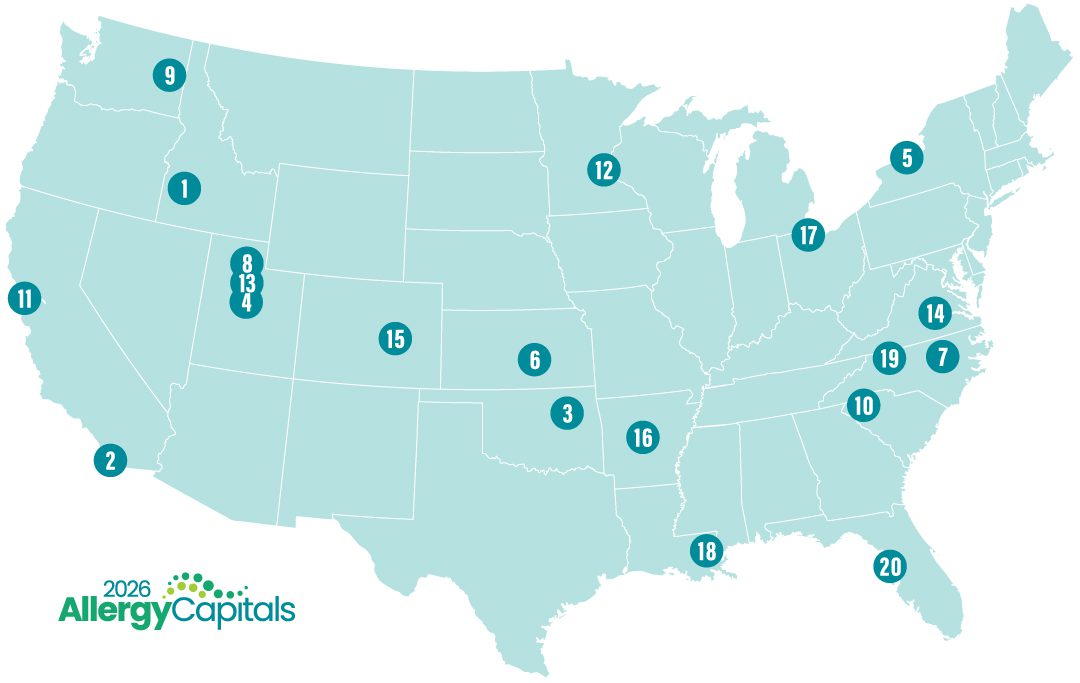
The top 10 most challenging places to live with seasonal allergies are:
- Wichita, Kansas
- New Orleans, Louisiana
- Oklahoma City, Oklahoma
- Tulsa, Oklahoma
- Memphis, Tennessee
- Little Rock, Arkansas
- Raleigh, North Carolina
- Richmond, Virginia
- Greenville, South Carolina
- Greensboro, North Carolina
*AAFA studied data from the 100 most-populated U.S. metropolitan areas.
2025 Allergy Capitals: Full Report
The report looks at these important factors:
- Tree, grass, and weed pollen scores throughout the year
- Over-the-counter allergy medicine use
- Availability of board-certified allergists/immunologists
This year’s report named Wichita, Kansas, as the top 2025 Allergy Capital for the third year in a row due to its:
- Worse-than-average tree and grass pollen
- Worse-than-average allergy medicine use
- Worse-than-average number of board-certified allergists/immunologists
Report Highlights
This year’s report focuses on these topics related to seasonal allergies:
- Types of pollen
- Allergic rhinitis and allergic asthma
- Managing your pollen allergies
- Climate change and urban areas
- Pollen counting
Tree, Grass, and Weed Pollen
Most of the pollen that causes allergic reactions comes from trees, grass, and weeds.
Tree pollen is the first pollen to appear each year in the U.S. Trees produce the most pollen from February through April. And in some regions, such as the South, trees may produce pollen as early as December or January.3
Grass pollen causes most late spring and summer pollen allergy symptoms from April through early June.4
Then, depending on your location, weed pollen – especially ragweed pollen – can trigger symptoms starting in August and peaking in mid-September. Ragweed season may last 6 to 10 weeks until the first frost.5 Some parts of the U.S. now have pollen year-round.
Allergic Rhinitis and Allergic Asthma
Pollen can cause symptoms for people with two common allergic conditions: seasonal allergic rhinitis (“hay fever” or “nasal allergies”) and allergic asthma.
Common symptoms of allergic rhinitis caused by seasonal allergies include:
- Runny nose (also known as rhinorrhea – usually a thin, clear discharge)
- Stuffy nose (due to blockage or nasal congestion)
- Sneezing
- Red and watery eyes
- Itchy nose, eyes, ears, or mouth
- Swelling around the eyes
Many people with asthma also have allergies. And allergies can trigger or worsen asthma. This is called allergic asthma. Common signs and symptoms of allergic asthma include:
- Shortness of breath
- Cough
- Chest tightness or pain
- Wheeze (a whistling sound when you breathe)
- Waking at night due to asthma symptoms
- A drop in lung function
Managing Your Pollen Allergies
Managing your seasonal allergies can help you keep your allergic rhinitis and allergic asthma well-controlled. Now more than ever there are a number of available and accessible options to help you find relief.
Work with your doctor to include the steps below in your allergy treatment plan:
- Prevent pollen from getting into your eyes, nose, mouth, and lungs
- Manage your contact with pollen
- Use allergy medicines and treatments to control your symptoms
- Rinse out your nose with a saline solution
- Ask your doctor about immunotherapy
Read the report to find more tips on how to manage your pollen allergies, no matter where you live.
Allergy Medicine Guide
Nasal rinse: Using a saline (saltwater) nose rinse can help cut down mucus and rinse allergens out of your nose. Remember to use these as directed. This does not protect against the allergen but can help with nasal symptoms.
Corticosteroid nasal sprays reduce inflammation (swelling) in the nose and block allergic reactions from developing. They are the most effective medicine type for allergic rhinitis because they can reduce all symptoms, including nasal congestion. They can also provide some relief for eye allergy symptoms. Nasal corticosteroids have few side effects (e.g., headache, nose bleeds or irritation). Many are now available over-the-counter without prescription.
Corticosteroid nasal sprays: FLONASE®, Nasacort®, Nasonex™, Nasalide/Flunisolide, Omnaris™, QNASL®, RHINOCORT®
Antihistamines relieve sneezing and itching in the nose and eyes. They also reduce a runny nose and, to a lesser extent, nasal stuffiness. Look for a long-acting, non-drowsy antihistamine. The newer forms do not carry the risk of toxicity (like feeling drowsy) that has been associated with older antihistamines like diphenhydramine. Certain antihistamines may come as nasal sprays.
Non-steroidal antihistamine nasal sprays (may cause drowsiness): Astelin®, Astepro®, Patanase®
Non-drowsy oral antihistamines: Allegra®, CLARINEX®, Claritin®
Oral antihistamines that may cause drowsiness in some individuals: Xyzal®, ZYRTEC®
Cetirizine (ZYRTEC®) and loratadine (Claritin®) are the antihistamines of choice for use during pregnancy. They have established safety profiles and are effective in treating allergy symptoms during pregnancy.
Diphenhydramine and related short-acting antihistamines (like promethazine) should be avoided. Diphenhydramine (known under the brand name BENADRYL®) is not a good choice to take for allergy symptoms because of its short-term action to manage symptoms and several known negative side effects. The major side effects of diphenhydramine and older generation antihistamines include drowsiness, sedation, dry mouth/eyes, and fatigue. This can also impair alertness, concentration, multitasking, and memory. In turn, this antihistamine can affect important functions, such as learning and test performance in children, as well as operation of machinery and cars in adults. As these medicines can impair you, they can affect work performance and safety. Side effects may worsen with higher dosing that is used for other conditions such as chronic hives.
Eye drops: Allergy eye drops can relieve eye burning, itchiness, redness, increased tearing, and swelling. These can come in a few types - antihistamine, mast cell stabilizers, and steroid eye drops. Many antihistamine eye drops are sold over the counter.
Antihistamine eye drops: Azelastine/Optivar, Bepreve®, Elestat®, LASTACAFT®, Opcon-A®, Systane® ZADITOR®, Patanol™, and Pataday®
Decongestants help shrink the lining of the nasal passages and relieve nasal stuffiness. They generally are only used for a short time (3 days). Read the instructions carefully and do not use them for extended amounts of time. Extended use of decongestant nasal sprays can cause a rebound effect that worsens your congestion. Make sure you talk with your doctor about the appropriate use of decongestants, limitations, and potential side effects.
Nasal spray decongestants: Afrin®, Vicks Sinex™
Oral decongestants: SUDAFED®
Some allergy medicines combine an antihistamine with a decongestant. Certain types of combo medicines (such as the ones that contain pseudoephedrine as the decongestant) are available “behind the counter”. Behind-the-counter products are available without a prescription but have limitations on purchases due to state and federal laws. Talking with pharmacy staff is generally necessary to obtain these types of allergy medications.
Decongestant + antihistamine combos: Allegra-D®, Claritin-D®, Clarinex-D, ZYRTEC-D®
Check with your doctor before using decongestants if you have high blood pressure, heart disease, glaucoma, thyroid disease, or trouble urinating. They may cause issues if you have any of these conditions and they may interact with other prescription medicines.
Federal Regulations on Decongestants
The oral form of phenylephrine (PE) is a common active ingredient in many OTC decongestants. An expert panel of the FDA reviewed studies which showed oral PE is not effective at relieving nasal congestion in commonly used doses. The FDA is proposing to end use of oral PE. This would remove these products from the U.S. market. The change would not affect the nasal spray forms of PE.
Decongestants that contain pseudoephedrine (PSE) require photo identification and are only available to purchase behind the pharmacy counter.
Cromolyn sodium is a nasal spray that blocks your body from releasing chemicals (such as histamine and leukotrienes) that cause allergy symptoms including histamine and leukotrienes. This medicine has few side effects, but you must take it three to six times a day. For optimal results, this medication should be used daily during your allergy season. It can be started up to one week before your allergy season begins.
Cromolyn sodium nasal spray: NasalCrom®
Leukotriene receptor antagonists (or modifiers) block the action of important chemical messengers (other than histamine) that are involved in allergic reactions. These medicines help manage asthma and allergic rhinitis symptoms. These medications are taken orally. How often you take them depends on the specific drug. Discuss the appropriate use of these medications with your doctor, including the risks and benefits of therapy.
Options include: ACCOLATE®, SINGULAIR®*, Zyflo CR®
*Note: Montelukast (brand name SINGULAIR®) has a black box warning because it can cause serious mental health side effects. This is a safety warning from the Food and Drug Administration (FDA). This means you need to be aware of a drug’s side effects or important instructions for safe use of the drug. We encourage you to speak with your health care provider before, during, and after the start of any new medicine. If your doctor recommends montelukast, talk with them about possible risks and concerns.
Medical Review: March 2025 by John James, MD
Climate Change and Urban Areas
Climate change is leading to longer and more intense allergy seasons.6,7,8 Warmer temperatures mean plants start growing sooner and they produce more highly allergenic pollen. Allergenicity means the strength of the allergic response to pollen. More exposure to pollen can trigger asthma and other allergic responses.
Even though trees are a source of pollen, they also help regulate climate. Trees remove CO2 from the atmosphere and store it. The shade from trees helps reduce surface temperature, and forests reduce flooding.
Urban areas with fewer trees have higher temperatures due to more surfaces that trap heat at ground-level, like buildings and roads. When a city area is warmer than a rural area due to these heat-absorbing surfaces, this is called an “urban heat island.” Read the report to learn more about the effects of climate change on pollen production, and what can be done to slow it down.
Pollen Counting
Pollen reports are valuable tools in helping you manage your seasonal allergies. But not all reports are equal. Some reports are pollen counts and some are pollen forecasts. While pollen forecasts can be helpful, pollen counts are more accurate.
Pollen sensors play an important role in gathering accurate pollen counts to help diagnose and treat allergies, study the impact of climate change, and produce crop forecasts.9,10 The 2025 Allergy Capitals report looks at the importance of pollen counts and possible solutions to improve pollen monitoring by using automated pollen sensors.
Frequently Asked Questions about Allergy Capitals
What Does It Mean If I Live in an Allergy Capital Lower on the List?
You may still be greatly affected by seasonal allergies. On one or more of the ranked factors, your city may be doing better compared to other cities. For example, your city may have more allergists available compared to other cities.
What Does It Mean If My City Isn’t Listed on the Report?
AAFA’s Allergy Capitals report ranks the top 100 populated metro areas in the United States. If your hometown is near a major city, your area may be included in the metro area of the major city. For example, the Seattle metropolitan area includes Tacoma, Bellevue, Everett, and all cities and suburbs in the surrounding area.
If your city’s population is lower than the population of the 100th most populated city, then your city will not be ranked. You may be greatly affected by seasonal allergies, but your town is not reflected in the report.
How Can I Get Relief from Seasonal Allergies?
No matter where you live, it’s hard to escape pollen. But you can manage your pollen allergy.
There are a number of available and accessible options to help you find relief. Work with your doctor to include the steps below in your allergy treatment plan:
- Manage your contact with pollen
- Use allergy medicines and treatments
- Rinse out your nose
- Ask your doctor about immunotherapy
Learn more about managing pollen allergies.
Acknowledgement
The 2025 Allergy Capitals report is an independent research project of the Asthma and Allergy Foundation of America and made possible by support from Opella.
AAFA thanks Pollen Sense, Komodo Health, and Circana for their support with data and report content.
The views and opinions expressed in this report are those of the AAFA authors and do not necessarily reflect the policies or positions of other individuals, sponsors, organizations, or companies.
Recommended Citation
Asthma and Allergy Foundation of America, (2025). 2025 Allergy Capitals. Retrieved from allergycapitals.com.
Media Inquiries
For media and related inquiries, contact gro.afaa@aidem.
Closed
Drug Company Assistance Programs
The medicines covered by the programs below may change at any time. The following medicines are covered as of Jan. 24, 2025.
Company:
- AstraZeneca
Medicines offered:
- AIRSUPRA®
If you have commercial insurance: If you have employer-provided or individual private (commercial) insurance, you may be able to get AIRSUPRA for as low as $0 with the SUPRA Savings Card.
If you have government insurance: For people with Medicare Part D coverage, the average out-of-pocket cost is $89 per month. For people with Medicaid, the out-of-pocket costs range from $.99-$13 per month. Some states offer even lower copays or eliminate the copay altogether. If you have Medicare Part D and cannot afford AIRSUPRA, you may be eligible for the patient assistance program, AZ&Me.
If you have no insurance: If you do not have health insurance or your insurance does not cover AIRSUPRA, you will pay the amount determined by your pharmacy. You may also be eligible for the patient assistance program, AZ&Me.
Learn more on the Cost Assistance with AIRSUPRA website or call 866-480-0030.
Company:
- AstraZeneca
Medicines offered:
- BEVESPI AEROSPHERE®
- BREZTRI AEROSPHERE®
- SYMBICORT®
- FASENRA®
- TEZSPIRE®
If you have commercial insurance, government insurance, or no insurance:
AstraZeneca US Patient Support offers various savings for several of their medicines. They offer copay savings cards and patient assistance programs depending on what type of insurance you have.
For more information, visit AZPatientSupport or call 800-236-9933.
AstraZeneca has capped the cost of their inhalers to $35 if you have commercial or private insurance. Learn more about the price cap.
Company:
- AstraZeneca
Medicines offered:
- TEZSPIRE®
If you have commercial insurance: The TEZSPIRE Together Co-Pay Program can help may help you save regardless of income if you qualify. Get doses for as little as $0 and up to $100 off your in-office administration costs (pre-filled syringe only). Learn more on the TEZSPIRE Together Co-Pay Program website or call 888-987-7473.
If you have government insurance: The TEZSPIRE Together Program, you may be able receive TEZSPIRE at no cost if you qualify. This includes people who:
- Are uninsured
- Have Medicare Part B with no supplemental insurance
- Have a Medicare Advantage plan with an affordability gap
- Have insurance that does not cover TEZSPIRE
For more information, call 888-987-7473.
Company:
- Boehringer Ingelheim
Medicines offered:
- Atrovent® HFA
- Combivent® Respimat®
- Spiriva® Respimat®
- Stiolto® Respimat®
- Striverdi® Respimat®
If you have commercial insurance or don’t have insurance: If you qualify, your cost will automatically be discounted when you buy these inhalers at participating retail pharmacies. If your cost is more than $35, download and use a savings card. Learn more at: InhalerOffer.com
If you have government-funded insurance: If you use Medicare, Medicaid, CHIP, or TRICARE, visit the Boehinger Cares Patient Assistance Program webpage or call 800-556-8317 to apply for assistance.
Boehringer Ingelheim has capped the cost of their inhalers to $35 if you have commercial or private insurance. Learn more about the price cap.
Company:
- Sanofi and Regeneron Pharmaceuticals, Inc.
Medicines offered:
- DUPIXENT®
If you have commercial insurance: The Dupixent MyWay® Copay Card may help you lower the cost of your copay. Learn more on the Dupixent MyWay Copay Card website or call 844-DUPIXENT (844-387-4936), option 1.
If you don't have insurance or your insurance doesn’t cover Dupixent: You can apply for the DUPIXENT MyWay Patient Assistance Program. For more information or to sign up, call 844-DUPIXENT (844-387-4936), option 1.
If you have Medicare: At this time, there is not a savings program for Dupixent if you have Medicare. Call 844-DUPIXENT (844-387-4936), option 1 for more information.
If you have Medicaid: Your copay and coverage may vary depending on what state you live in. If you meet the criteria, you may also be able to get help from the DUPIXENT MyWay Patient Assistance Program. For more information or to sign up, call 844-DUPIXENT (844-387-4936), option 1.
Medicines covered:
- Epinephrine devices – all brands
Savings programs:
- See AAFA’s list of all available epinephrine devices and their patient assistance programs.
Company:
- Genentech
Medicines offered:
- Xolair®
If you have commercial insurance: Genentech offers a copay savings program for Xolair. You may also be able to get help from an independent copay assistance foundation. ![]()
If you have government insurance or don’t have insurance: You may be able to get help from an independent copay assistance foundation. Find programs. ![]()
Company:
- GSK (GlaxoSmithKline)
Medicines offered:
- ARNUITY ELIPTA
- ANORO ELLIPTA
- BREO ELLIPTA
- INCRUSE ELLIPTA
- NUCALA®
- SEREVENT®
- TRELEGY®
If you have commercial insurance: You may be eligible for the GSK Copay Assistance Program.
If you have Medicare or no insurance: You may qualify for the GSK Patient Assistance Program. This program can help you receive certain GSK prescription medicines and vaccines at no cost.
For more information, visit GSK Patient Assistance Program & Savings Offers or call 888-825-5249.
GSK has capped the cost of their inhalers to $35 if you have commercial or private insurance. Learn more about the price cap.
Company:
- GSK (GlaxoSmithKline)
Medicines offered:
- NUCALA®
If you have commercial insurance: If you have a commercial medical or prescription insurance plan, you may be able to take part on the NUCALA Copay Program. If you are approved, the GSK Copay Program may help with your cost share for NUCALA and the your cost share for administration up to the total annual copay program maximums.
If you have government insurance or no insurance: You are not eligible for this program if you are covered by any federal or state prescription insurance program.
For more information, visit the NUCALA Copay Program website or call 800-691-1939.
Company:
- Organon
Medicines offered:
- ASMANEX® HFA
- ASMANEX® TWISTHALER®
- DULERA®
If you have commercial insurance: If you qualify, you may be able to save with an ASMANEX Multiuse Savings Coupon.
If you qualify, you may pay as little as $15 per Dulera prescription on each of up to 12 qualifying prescriptions. The maximum savings is $90 per prescription.
If you have government insurance or no insurance: At this time, there is no assistance program if you have Medicaid or Medicare.
Company:
- Teva
Medicines Covered:
- QVAR RediHaler®
- CINQAIR®
Teva Cares Patient Assistance Program provides certain Teva medicines at no cost if you live in the United States and meet specific insurance and income criteria. Learn more about program eligibility.
If you do not meet the eligibility requirements for the Teva Cares Foundation Patient Assistance Programs, you may be eligible for help from other programs they offer.
For more information, visit the Teva Cares Foundation website or call 888-838-2872.
Pharmacy Drug Savings Programs
Program Name:
Contact Information:
- 844-265-6444
- moc.htlaehknilb@ofni
About the Program:
- Blink Health finds the lowest price for the medicines you need. Find discounted prescription prices on more than 15,000 medicines.
Program Name:
Contact Information:
- 844-926-2480
- moc.xrknilb@troppus
About the Program:
- BlinkRx is a digital pharmacy service that carries certain medicines. They can provide the lowest prescription price while providing free home delivery.
Program Name:
Contact Information:
- 855-268-2822
About the Program:
- GoodRx is a free resource that lets you compare medicine prices and find discounts.
Looking for savings on asthma inhalers? See the GoodRx Savings Guide for ways you may be able to save money on 25 asthma inhalers.
Program Name:
Contact Information:
- 833-317-2937
About the Program:
- The Kroger Health Savings Club is an annual membership program that entitles members to reduced prices on prescription drugs.
Program Name:
Contact Information:
About the Program:
- Mark Cuban CostPlus Drug Company offers access to affordable medicines at the lowest possible price. Learn about program eligibility.
Program Name:
Contact Information:
- 888-331-1002
About the Program:
- The SCBN Prescription Assistance program is for uninsured or underinsured people who cannot afford their prescribed medicines.
- The program requires a membership fee to participate.
Program Name:
Contact Information:
- Contact your local Walmart pharmacy
About the Program:
- The Walmart low-cost Prescription Program includes up to a 30-day supply for $4 and a 90-day supply for $10 of some covered generic drugs at commonly prescribed dosages. Prices for some drugs covered by the program may vary by state.
Program Name:
Contact Information:
- 877-296-4673
About the Program:
- Prescription Hope provides access to brand-name medicines for only $60 a month per medication through their medication access service. Learn about program eligibility.
Nonprofit Copay and Premium Assistance Programs
Organization:
Contact Information:
- 800-511-5144 (TTY 711)
- moc.htlaehairaca@eracremotsuc
About the Program:
- AcariaHealth provides specialty pharmacy services for people living with complex and chronic health conditions. Their Copay Assistance Support Team will research and apply to qualifying patient assistance programs on behalf of the patient. Learn about the program.
Organization:
Contact Information:
- 800-366-7741
About the Program:
- Accessia Health provides financial help to pay for copays, health insurance premiums, travel costs, and other medical expenses. Learn about program eligibility.
Organization:
Contact Information:
- 877-968-7233
About the Program:
- Good Days provides financial support for people who cannot afford the treatment they urgently need.
- Copay, travel, premium, and diagnostic testing assistance may be available.
- Learn about eligibility criteria.
Organization:
Contact Information:
- 980-859-3483
- gro.htaprobrah@ofni
About the Program:
- Harbor Path delivers lifesaving medicine for free to people who are uninsured. They currently serve 24 states. Use the eligibility calculator to see if you qualify.
Organization:
Contact Information:
- 800-675-8416
- gro.noitadnuofllewhtlaeh@stnarg
About the Program:
- HealthWell Foundation provide financial assistance to help with prescription copays, travel costs, behavioral health services, health insurance premiums, deductibles, and copays. Please note that diseases covered may change from time to time.
Organization:
Contact Information:
- 866-316-7263
About the Program:
- The PAN Foundation offers financial help for out-of-pocket medicine costs including copays, health insurance premiums, and transportation costs related to medical care. Learn about program eligibility. Please note that diseases covered may change from time to time.
Organization:
Contact Information:
- 866-512-3861
About the Program:
- PAF’s Co-Pay Relief (CPR) program provides direct financial help to qualified people with co-payments, co-insurance or cost-sharing associated with prescription drugs through funds for specific disease states. Learn about program eligibility. Please note that diseases covered may change from time to time.
Organization:
Contact Information:
- 800-769-3880
About the Program:
- Rx Outreach provides discounted medicines for eligible people. Learn about the program.
Organization:
Contact Information:
- 855-845-3663
About the Program:
- TAF helps people and families by providing them with financial help for their copays, coinsurance, premiums, deductibles, and other health-related expenses.
Patient Assistance Tools and Databases
Tool:
- BenefitsCheckUp® – National Council on Aging
Contact Information:
- 800-794-6559
More Information:
- BenefitsCheckUp® is a free service of the National Council on Aging (NCOA). It is an online tool to connect older adults and people with disabilities to benefit programs such as health care, medicine, food, utilities, and more.
Tool:
Contact Information:
- 615-736-5075
- gro.epohfoyrasnepsid@ofni
About the Program:
- Dispensary of Hope provides medicine to communities, free of cost. They are a charitable medication distributor dedicated to providing pharmacies and clinics with reliable access to medication that was generously donated by pharmaceutical manufacturers. Find a dispensing site near you, here.
Tool:
Contact Information:
- 800-503-6897
- gro.sdemydeen@ofni
More Information:
- A national nonprofit that connects people to programs that may help them afford their medicines and other health care costs.
Tool:
- PhRMA’s Medicine Assistance Tool (MAT) – Partnership for Prescription Assistance
Contact Information:
- 571-350-8643
More Information:
- PhRMA’s Medicine Assistance Tool (MAT) is a search engine for many patient assistance resources offered by drug makers.
Tool:
Contact Information:
More Information:
- RxAssist offers a comprehensive database of patient assistance programs. Learn about the eligibility requirements.
Tool:
Contact Information:
- 844-234-3057
- moc.eracelgnis@troppus
More Information:
- SingleCare works with pharmacies on discounts on prescriptions. Look up prescriptions to find the lowest prices in your area.
Tool:
Contact Information:
- 800-719-5147
- moc.esnesxr@rednifsgnivasxr
About the Program:
- Walgreens Rx Savings Finder can help you find prescription discount cards that can help you find the lowest price on a medicine at Walgreens.
State Drug Assistance Programs
Organization:
- Extra Help – Social Security Administration
Contact Information:
- 800-772-1213
- (TTY 800-325-0778)
More Information:
- The Extra Help program helps people with limited income and resources lower or cut Medicare Part D costs.
Organization:
- State Health Insurance Assistance Programs (SHIPs) – National Technical Assistance Center
Contact Information:
- 877-839-2675
- gro.htlaehpihs@ofni
More Information:
- Free insurance counseling and help to Medicare-eligible people, their families, and caregivers.
Organization:
Contact Information:
- Contact your local county office.
More Information:
- CalAIM offers people on Medi-Cal access to services that address physical, behavioral, developmental, dental, and long-term care needs.
Organization:
- State Pharmaceutical Assistance Program – Medicare.gov
More Information:
- Find out if your state has a state pharmaceutical assistance program.
Organization:
- Pharmaceutical Assistance Program – Medicare.gov
More Information:
- Learn more about pharmaceutical companies that offer programs to help pay for prescriptions for people with a Medicare Drug Plan (Part D).
Community Resources
American Sleep Apnea Association: Assists people with sleep apnea who cannot afford their CPAP mask supplies through the CPAP Assistance Program.
Friends of Man: Receives applications for mobility equipment, prosthetics, home modifications, medical equipment, hearing aids, basic needs and much more. The referral must be made by a professional. This includes caseworkers, case managers, health care workers, social workers, school counselors, teachers, and clergy.
FoodFinder: A map of food pantries across the United States. Search your ZIP code to learn about free food assistance programs near you.
FundFinder: Helps you find financial assistance from charitable foundations.
Inspira Financial: Funds in a health savings account (HSA) or a health care flexible spending account (FSA) can be used for eligible medical expenses.
Society of St. Vincent de Paul: A national non-profit that provides local assistance and services.
United Way 211: The most comprehensive source of information about local resources and services in the country.
AAFA Regional Chapters
The AAFA New England Chapter has more information on drug assistance for Massachusetts residents.
The AAFA Michigan Chapter has more information on drug assistance for Michigan residents, including the Jared Williams Medication Fund (JWMF).
.
Using Certified Asthma & Allergy Friendly® products in your home can help you have a healthier indoor environment, as well as reduce allergens.
To learn more about the Asthma & Allergy Friendly® Certification Program, visit: aafa.org/certified