





Asthma
Vaccine Recommendations for People with Asthma and Allergies
People with asthma have a higher risk of getting serious symptoms and complications from vaccine preventable illnesses like pneumonia, the flu (influenza A or B), pertussis (whooping cough), respiratory syncytial virus (RSV), or COVID-19. Protecting yourself and your loved ones from vaccine preventable illnesses is important and can be as simple as a talk with your healthcare provider as vaccines can help reduce illness, the severity of illness, and even death.
Benefits and Risks of Vaccines
Vaccines can help protect you, your loved ones, older adults near you, teachers, and essential workers from getting a respiratory infection. Being vaccinated can also cut down your symptom severity if you do get sick. Vaccines may need a few weeks or months to start working before a respiratory season. Vaccines reduce the burden on our health care system by reducing the number of people who get sick. Some vaccines also help protect against developing long-term diseases, disability, or cancer.
Most side effects from vaccination are mild such as soreness, redness, or swelling at the shot site. Some people may have a low-grade fever or headache. Very small numbers of people have more serious side effects such as an allergic reaction. The risk of a vaccine causing serious harm is very small. The benefits to getting a vaccine are much greater than the small chance of side effects.
Vaccines are the best way to protect yourself against infectious diseases. They are safe and have been through many phases of testing, spanning many years. Vaccines are required to go through a rigorous testing process to ensure the best safety measures and standards met. They are monitored and tested, even after they are shown it is safe for public use.1
If you have questions on the risks or benefits of vaccines, talk with your health care provider. It is important that you advocate for yourself and your loved ones. You can do this by having a conversation on what’s best for you and your health with your health care provider.
Why Are Vaccines Important for People with Asthma?
During an asthma episode, your airways narrow, swell and become blocked with mucus – making it hard to breathe. Some illnesses can have similar effects on your lungs, or worsen lungs already swollen at baseline from asthma. When you have asthma and you get sick with certain lung infections, it can sometimes lead to a higher chance of serious health problems – even death.
It is important that people with asthma and their loved ones get vaccines to reduce the risk of these preventable diseases.
It’s important to always keep your asthma under control. If your asthma is well-controlled when you get sick, you reduce your chances of having an asthma attack, having complications, or staying in the hospital. Vaccines are just one important way you can help keep your asthma under control.
Flu (Influenza) Vaccine
The flu is a highly contagious virus that attacks the nose, throat and lungs. Infected people are contagious one day before developing symptoms and up to seven days after getting sick. There are approximately 27,000 – 130,000 deaths and 610,000 – 1,3000,000 hospitalizations from the flu each year. The flu illness comes at a high cost and burdens our health care system.2
The best way to protect yourself and your community is to get a flu vaccine every fall before flu outbreaks begin. It takes about 2 weeks after you receive the flu vaccine for the antibodies that protect against flu, to fully develop. Flu vaccines only last a season and need to be updated each year. The flu strains that make up the vaccine change on a year-to-year basis according to which strain is most common. Some years the vaccine may work better than others. but overall The protection from the flu vaccine is better than not being vaccinated at all. AAFA recommends all people age 6 months and older get a flu vaccine. It is especially important for people with asthma who are more likely to have severe complications from the flu.
You cannot get the flu from any form of flu vaccine. People with egg allergy can safely and routinely receive either the regular or nasal flu vaccine, even though it contains very tiny amounts of egg.
Talk with your doctor about the flu vaccine if you:
- Take care of a child 6 months of age or older
- Are pregnant or breastfeeding
- Are ready to get your flu shot!
COVID-19 Vaccine
COVID-19 is a disease caused by the virus SARS-CoV-2. COVID-19 affects many different parts of the body, including the lungs, stomach, heart, blood vessels, and brain. COVID-19 is primarily a respiratory system (breathing) disease, but experts believe it can also affect the vascular (blood vessel) and neurologic (nervous system) systems. It can lead to long-term, serious health problems known as long COVID.
COVID-19 symptoms can feel like a cold, the flu, or pneumonia. Most people have mild to moderate symptoms, but some may have more severe symptoms and complications which can lead to death. Between 13-20 million people had COVID in 2024-2025 leading to:
- About 4 million people to visit their doctor
- Over 500,000 people to be hospitalized
- Between 44,000-63,000 to die
COVID-19 symptoms may change based on the strain at the time. The COVID-19 vaccine is a vaccine you need to get every year, because the strains change and the protection is short-acting. Everyone ages 6 months and older can get a COVID-19 vaccine.
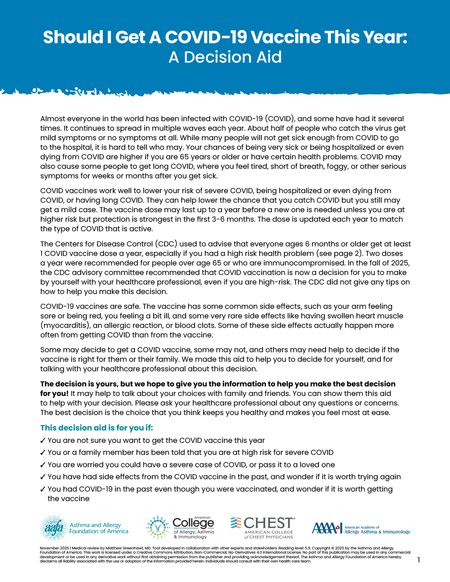
The Centers for Disease Control (CDC) used to advise that everyone get at least 1 COVID vaccine dose a year, especially if you had a high-risk health problem. Two doses a year were recommended for people over age 65 or who are immunocompromised. In the fall of 2025, the CDC advisory committee recommended that COVID vaccination is now a decision for you to make by yourself with your healthcare professional, even if you are high-risk.
COVID-19 vaccines are safe. The vaccine has some common side effects, such as your arm feeling sore or being red, you are feeling a bit ill, and some very rare side effects like having swollen heart muscle (myocarditis), an allergic reaction, or blood clots. Some of these side effects happen more often from getting COVID than from the vaccine.
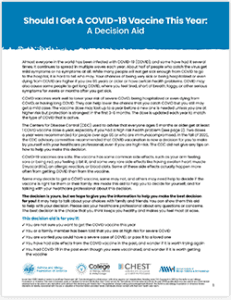 AAFA developed a COVID-19 decision aid to help you decide if the COVID-19 vaccine is right for you. The decision aid provides information about risk factors for severe illness from COVID. It also answers some common questions about the vaccine.
There are currently four vaccines available: Comirnaty, Spikevax, Mnexspike, and Nuvaxovid. You can talk with your doctor about getting the vaccine during your clinic appointment or you can also get the vaccine at some pharmacies.
Talk with your doctor before you get a COVID-19 vaccine if you:
- Are getting the vaccine for the first time and have questions
- Have a current moderate or acute (short-term) illness
- Have a current case of COVID-19
- Have a history of severe allergic reactions (anaphylaxis) to a vaccine or injectable medicine
High Risk Conditions for COVID-19
Cancer, stroke, kidney disease, liver disease, lung disease (including COPD and asthma), heart disease, cystic fibrosis, dementia, Parkinson’s disease, diabetes, disabilities, HIV infection, mental health conditions, tuberculosis (TB), pregnancy, overweight, high blood pressure, immunocompromised, organ transplant, or a current or former smoker.
Respiratory Syncytial Virus (RSV) Vaccine
Respiratory syncytial virus (RSV) is a common virus with cold-like symptoms that can affect people of all ages. RSV is the most common cause of pneumonia and airway inflammation (bronchiolitis) in children in the United States younger than 1 year of age. Children who get RSV when they are younger are at a higher risk of developing asthma.
RSV usually causes mild symptoms, though infants with smaller airways are at higher risk of their breathing muscles becoming too tired and failing. As the person gets older and the airways bigger, the symptoms become milder. Most people get better in a week or two. But RSV can be serious, especially for infants, older adults, people with asthma, and people who are immunocompromised. RSV infection as a young child may increase the risk of asthma.
An RSV vaccine is available for infants and babies, pregnant people, and some older adults.
Talk with your doctor about the RSV vaccine if you:
- Are an adult 75 years of age and older
- Are an adult 60 to 74 years and older AND at an increased risk of RSV disease (see risk factors in the section, “Who Is at High Risk from RSV?”)
- Live or work in a nursing home or long-term care facility
- Are 32 to 36 weeks pregnant during RSV season (usually September through January)
- Work in a daycare or childcare facility with infants and young children
- Would like to receive the RSV vaccine
Pneumococcal Vaccine
Pneumococcal [noo-muh-kok-uhl] disease (streptococcus pneumoniae) is a serious bacterial infection that can cause pneumonia, meningitis, bloodstream infections (sepsis), urinary tract infections (rarely), and ear infections. This is not the same strain of strep that causes throat infections.
Each year in the United States, pneumococcal disease kills thousands of adults, including 18,000 adults 65 years or older.
When the pneumococcal bacteria spread into the lungs, it causes pneumonia. Pneumonia is serious for someone with asthma.
There are two types of the pneumococcal vaccine—Prevnar and Pneumovax. These provide different protections. For more than two decades, children have been vaccinated with Prevnar. Prevnar in adults of a certain age has largely replaced Pneumovax as it lasts longer and offers better protection. However, talk with your health care provider to find out which one of them is right for you.
Talk with your doctor about the pneumococcal vaccine if you:
- Are an adult 50 years or older
- Are an adult 19 through 49 years old with certain risk conditions
- Would like the pneumococcal vaccine for your children younger than 5 years old
- Would like the pneumococcal vaccine for your children 5 through 18 years old with certain risk conditions
- Live or work in a nursing home or long-term care facility
Whooping Cough Vaccine
Whooping cough (pertussis) can cause violent and rapid coughing, over and over, until the air is gone from the lungs and you are forced to inhale with a loud “whooping” sound.
Whooping cough in infants and young children can be severe, cause hospitalization, and 1 in 100 very young infants may die. This is generally milder in teens and adults, especially those who have been vaccinated.3
The best way to protect against whooping cough is to get a vaccine.
Diphtheria, Tetanus, and acellular Pertussis (DTaP) vaccines are usually given when you are young (2, 4, 6, 12, 18 months, then 4 to 6 years) and are part of the vaccine series for babies.4,5 However, because the protection fades by the time most people reach adolescence, an additional booster of the tetanus, diphtheria, and acellular pertussis (Tdap) vaccine is given around 11 to 12 years of life.
If you received your pertussis vaccine many years ago, it is possible you need a booster. Talk with your doctor about what vaccines you may need.
Vaccine side effects from DTaP and Tdap are usually mild and go away on their own. Severe side effects (seizures, prolonged crying, high fever) are very rare but most likely to occur with DTaP than Tdap.
If you get the whooping cough vaccine, you are less likely to catch whooping cough. And if you do get sick with whooping cough even though you got the vaccine, you are more likely to recover quicker and easier, as well as have a lower risk of complications. The whooping cough vaccine can also help reduce you or your child’s risk of severe illness from more than one respiratory infection.
The DTaP and Tdap vaccine is available for infants and babies, pregnant people, and some older adults.
Talk with your doctor about the DTaP and Tdap vaccine if you:
- Think you may need a booster
- Need to schedule the vaccine series for your infant and young children
- You are an adult who was never vaccinated
- Are pregnant and/or breastfeeding
- Are an older adult and may need a booster
- Are immunocompromised
Shingles Vaccine
People with asthma might be at an increased risk for shingles. Varicella, which also causes chicken pox, is a virus that inflames the nerves to the skin, causes shingles. Shingles can only happen in someone who has had chicken pox—this virus stays asleep for decades and then can re-awaken, causing shingles. Unlike chicken pox, shingles only attack certain areas of the body in patches (sometimes only on one part of the body) that follow the nerve where it stayed asleep. Some people have severe pain. Very rarely, shingles can also lead to pneumonia. Shingles on the eye is a medical emergency.
All adults 50 yrs and over and those who are 19 yrs and older AND immunocompromised, can receive the shingles vaccine. Even people who have had shingles can receive the vaccine to help prevent another case of this painful disease.
Talk with your doctor about the shingles vaccine if you:
- Are over 50 years old
- Have a weakened immune system
- Take immunosuppressant medications
It is also important to remember, if there are changes to federal recommendations on any health issues like vaccines, medications, and/or treatments, these recommendations may affect your health insurance coverage. Remain up to date with your health insurance and coverage and know what is covered under your plan and what new costs may arise.
Medical Review: January 2026 by Matthew Greenhawt, MD
Closed
References
- Public Health Communications Collaborative. (2025). Vaccine Development, Safety, and Effectiveness. Retrieved January 6, 2026 from: https://publichealthcollaborative.org/topics/vaccine-development-safety-and-effectiveness/
- Centers for Disease Control and Prevention. (2025, May 9). Preliminary Estimated Flu Disease Burden 2024-2025 Flu Season. U.S. Department of Health and Human Services. Retrieved January 6, 2026 from: https://www.cdc.gov/flu-burden/php/data-vis/2024-2025.html
- Centers for Disease Control and Prevention. (2025, December 2). Symptoms of Whooping Cough. U.S. Department of Health and Human Services. Retrieved January 6, 2026 from: https://www.cdc.gov/pertussis/signs-symptoms/
- Mayo Clinic. (2025, March 15). Whooping cough: symptoms and causes. Retrieved January 6, 2026 from: https://www.mayoclinic.org/diseases-conditions/whooping-cough/symptoms-causes/syc-20378973
- Centers for Disease Control and Prevention. (2025, December 2). Whooping Cough Vaccination. U.S. Department of Health and Human Services. Retrieved January 6, 2026 from: https://www.cdc.gov/pertussis/vaccines/index.html