





Asthma

/ Asthma / Living With Asthma / School Health Care Plans for Asthma and Allergies

School Health Care Plans for Asthma and Allergies

If your child has asthma or allergies to food, latex, or stinging insects, you may have concerns about what happens during the school day when they are in the care of other people. It’s helpful to keep in mind that many schools already have policies in place to manage asthma and/or allergies. You need to partner with the school to set up a school health care plan for your child.1 It is an important part of your child’s asthma or allergy management plan to keep them healthy through the school year.

Types of School Health Care Plans

A school health care plan is a written set of documents that outlines your child’s medical condition and needs. The plan usually lists information about your child’s asthma or allergies, how they should be managed, and what to do in an emergency. It may also include school staff responsibilities, training, and services needed to help keep your child safe. A school health care plan often includes several forms and documents.

Three common types of school care plans are:

  • Emergency care plan (ECP) – This is a medical plan from your child’s doctor for the school to follow to treat asthma while the student is at school.
  • Individual health care plan (IHCP or IHP) – This is a type of nursing care plan. For a student with asthma, this would also include an emergency care plan. An IHCP addresses what the school will do to establish and maintain a safe school environment for the student with asthma.2
  • 504 plan – This is a legally binding plan written by the school in collaboration with a student and their family.3 Similar to an IHCP, this plan provides guidelines for changes in the classroom or other school locations to achieve the goal of providing a safe education.

Emergency Care Plans (ECP)

An ECP is the medical plan your child’s doctor writes for the school nurse to follow. ECPs usually use terms people with a non-medical background can also understand and follow.

Your child’s ECP should have:

  • Your child’s asthma triggers and/or allergens
  • Symptoms that require emergency treatment with quick-relief asthma medicine or an epinephrine auto-injector
  • Instructions on calling 911 to transport your child to the hospital
  • Emergency contacts

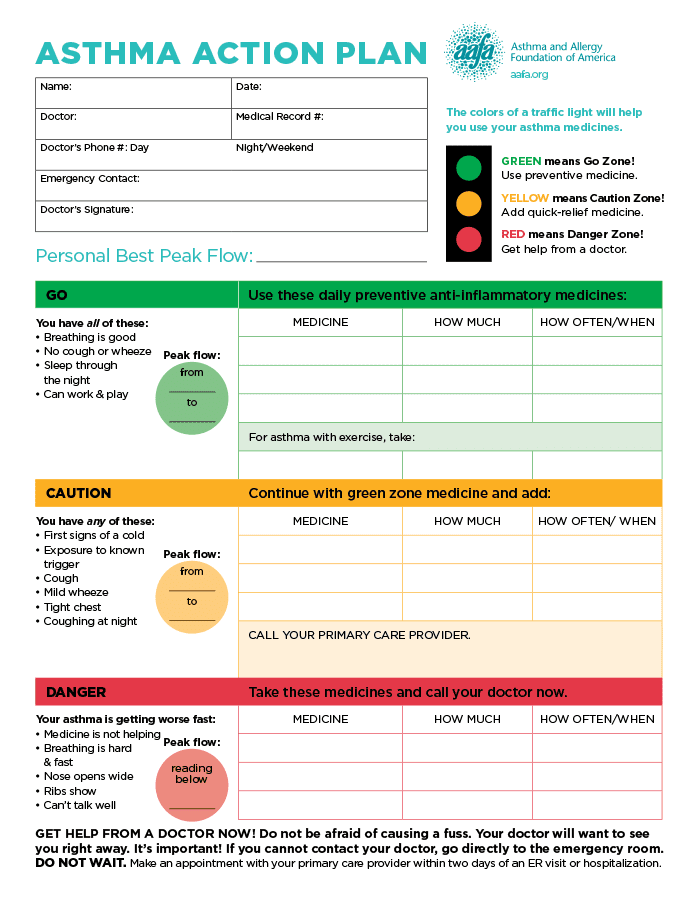
The ECP should include your child’s Asthma Action Plan or Anaphylaxis Action Plan. An ECP is usually part of an IHCP or 504 plan and must be signed by your child’s doctor.1

Individual Health Care Plans (IHCP or IHP)

An IHCP (sometimes called an IHP) is a nursing care plan that has both administrative and clinical purposes. It will probably have an ECP for managing and treating asthma symptoms or an allergic reaction.

The school nurse will work with you, your child, and their doctor(s) to write the IHCP.1

An IHCP outlines what the school will do to create and maintain a safe school environment for your child. For example, an IHCP will detail what school staff will do to reduce the risk of trigger or allergen exposure, recognize asthma symptoms or an allergic reaction, and give the appropriate treatment. An IHCP is not a legally binding document.

504 Plan

A 504 plan, sometimes called a “Section 504 plan,” is a legally binding plan between a school and a student. A 504 plan addresses what the school will do to create and maintain a safe school environment for your child.

The 504 plan is from Section 504 of the Rehabilitation Act of 1973. This is a federal law that states schools that get federal funding cannot exclude or discriminate against a student with a disability because of their disability.4

A disability under Section 504 is defined by the Americans with Disabilities Amendments Act (ADA) as a “physical or mental impairment which substantially limits one or more major life activities.” A “major life activity” can include activities such as walking, seeing, hearing, speaking, breathing, learning, working, and eating.5

The purpose of a 504 plan is basically the same as an IHCP. But a 504 plan is legally enforceable and offers safeguards a traditional IHCP doesn’t. With a 504 plan, a school division must follow certain procedures. Those procedures include notifying parents, an opportunity to review relevant records, an impartial due process hearing (with legal counsel, if desired), and procedures review. An IHCP can be integrated into either a 504 plan or an individualized education program (IEP) to make the IHCP’s terms enforceable.

How to Choose a School Health Care Plan

Which plan is best for your child? That depends.

Here are some things to consider as you decide:

  • The needs of your child
  • The school’s current policies and procedures for managing asthma and allergies
  • Federal and state disability laws, if applicable

If the school already has a solid plan in place for managing asthma and allergies, your child may not need a 504 plan. However, if your child is eligible for a 504 plan, you can work with the school division to develop a 504 plan. The terms of a 504 plan are legally enforceable. Your child may not be eligible for a 504 plan if their condition is not considered to be a disability or there are no records showing they have a disability.4 You as the parent can work in partnership with school personnel and your child’s doctor as appropriate to develop the contents of your child’s IHCP or 504 plan based upon their unique health and safety needs while at school.

How to Create a School Health Care Plan for Asthma or Allergies

Your child’s school may already have a process in place for creating care plans.

Start by contacting the school to ask who the point of contact is for creating a school health care plan for your child. Then request a meeting with the school representative to talk about your child’s needs and to ask questions about the school’s policies.

Use a positive tone when approaching the school. You are part of the team that will work together to keep your child healthy and safe at school. Communicate often, calmly, and confidently.

Make contact well before the school year starts – such as in the spring before. The first few days of school are very busy for staff. You’ll want to have everything in place before the first day of school.

Here are some questions you may want to ask at your meeting:

  • Does the school or school district have a nurse?
  • When can I meet with school staff responsible for my child, such as their teacher, coach, and dietary staff (if they have food allergies)?
  • Where will my child’s medicines be kept? Will they be easily accessible?
  • Are staff trained on how to manage asthma and allergies?
  • How does the school staff handle asthma episodes or attacks and allergic reactions?
  • How is bullying handled?

If you feel your child needs a 504 plan, also contact the school district’s Section 504 coordinator. Ask to have your child evaluated for a 504 plan.

Your child’s school health care plan may include:

  • Signs and symptoms of an asthma episode or attack or an allergic reaction
  • List of all asthma triggers and allergies
  • Asthma Action Plan and/or Anaphylaxis Action Plan
  • Medicine authorization form
  • Special dietary meals accommodation form for food allergies
  • What staff will be trained and how
  • Use and training of substitute teachers
  • When a school nurse is not on site, who will handle their responsibilities
  • Responsibilities of the parent, child, nurse, teacher, and other school staff
  • How school celebrations, recess, field trips, bus rides, etc. will be handled
  • Changes in the classroom, cafeteria, and elsewhere (such as no scented cleaners, no ozone-generating air cleaners, no latex balloons, etc.)
  • Avoiding the use of the child’s triggers or allergens in art projects and other lesson plans
  • Storage of safe snacks and a safe non-perishable lunch (if your child has food allergies) for special situations (such as forgotten lunches, evacuations, shelter-in-place situations)

A written school health care plan helps you, your child, and the school staff understand everyone’s roles in ensuring your child’s safety and care while at school. It can reduce miscommunication, as well.

What to Do If the School Will Not Work with You

Public or private schools that get funds from the federal government have to follow Section 504 and the Individuals with Disabilities Education Act (IDEA). Public schools must provide a “free and appropriate education (FAPE) in the least restrictive environment under both Section 504 and the IDEA.”6

The ADA protects against disability discrimination and applies to both public schools and non-religious private schools. regardless of whether they receive any federal funding.6 Public and private schools are considered public accommodations under the ADA, and therefore have to take necessary steps to make sure a child is not excluded, denied services, or treated differently due to their disability (unless they can demonstrate that taking such steps would fundamentally alter the nature of their facility or result in undue burden).7 As a recent agreement with the Department of Justice indicated, these obligations can include the requirements to administer emergency medicine such as epinephrine devices.

If a public school is not willing to accommodate your child, contact your school district’s superintendent or Section 504 coordinator in writing. If you continue to be unhappy with the plan as implemented by the school district, you can contact the Department of Education’s Office for Civil Rights (OCR) or file a suit in a federal court.3

Stay Positive and Proactive

Remember to stay positive and focus on the goal: to ensure your child is healthy and included at school.

Work with the school on the best way to accommodate your child and their health needs.

School planning is a process. The first year involves a little extra effort because you are starting from scratch. Once you have a plan, you will need to review and update it before each school year or sooner if your child’s conditions change. You may also have to repeat this entire process if your child changes schools and moves on to middle school and high school. Make this part of your yearly prep for the school year so your child can have a safe environment that allows them to focus on learning and not their asthma or allergies.

Reviewed August 2024 by Adrianna Del Principe, Esquire
Closed
Drug Company Assistance Programs

The medicines covered by the programs below may change at any time. The following medicines are covered as of Jan. 24, 2025.


Company:

  • AstraZeneca

Medicines offered:

  • AIRSUPRA®

If you have commercial insurance: If you have employer-provided or individual private (commercial) insurance, you may be able to get AIRSUPRA for as low as $0 with the SUPRA Savings Card.

If you have government insurance: For people with Medicare Part D coverage, the average out-of-pocket cost is $89 per month. For people with Medicaid, the out-of-pocket costs range from $.99-$13 per month. Some states offer even lower copays or eliminate the copay altogether. If you have Medicare Part D and cannot afford AIRSUPRA, you may be eligible for the patient assistance program, AZ&Me.

If you have no insurance: If you do not have health insurance or your insurance does not cover AIRSUPRA, you will pay the amount determined by your pharmacy. You may also be eligible for the patient assistance program, AZ&Me.

Learn more on the Cost Assistance with AIRSUPRA website or call 866-480-0030.


Company:

  • AstraZeneca

Medicines offered:

  • BEVESPI AEROSPHERE®
  • BREZTRI AEROSPHERE®
  • SYMBICORT®
  • FASENRA®
  • TEZSPIRE®

If you have commercial insurance, government insurance, or no insurance:

AstraZeneca US Patient Support offers various savings for several of their medicines. They offer copay savings cards and patient assistance programs depending on what type of insurance you have.

For more information, visit AZPatientSupport or call 800-236-9933.

AstraZeneca has capped the cost of their inhalers to $35 if you have commercial or private insurance. Learn more about the price cap.


Company:

  • AstraZeneca

Medicines offered:

  • TEZSPIRE®

If you have commercial insurance: The TEZSPIRE Together Co-Pay Program can help may help you save regardless of income if you qualify. Get doses for as little as $0 and up to $100 off your in-office administration costs (pre-filled syringe only). Learn more on the TEZSPIRE Together Co-Pay Program website or call 888-987-7473.

If you have government insurance: The TEZSPIRE Together Program, you may be able receive TEZSPIRE at no cost if you qualify. This includes people who:

  • Are uninsured
  • Have Medicare Part B with no supplemental insurance
  • Have a Medicare Advantage plan with an affordability gap
  • Have insurance that does not cover TEZSPIRE

For more information, call 888-987-7473.


Company:

  • Boehringer Ingelheim

Medicines offered:

  • Atrovent® HFA
  • Combivent® Respimat®
  • Spiriva® Respimat®
  • Stiolto® Respimat®
  • Striverdi® Respimat®

If you have commercial insurance or don’t have insurance: If you qualify, your cost will automatically be discounted when you buy these inhalers at participating retail pharmacies. If your cost is more than $35, download and use a savings card. Learn more at: InhalerOffer.com

If you have government-funded insurance: If you use Medicare, Medicaid, CHIP, or TRICARE, visit the Boehinger Cares Patient Assistance Program webpage or call 800-556-8317 to apply for assistance.

Boehringer Ingelheim has capped the cost of their inhalers to $35 if you have commercial or private insurance. Learn more about the price cap.


Company:

  • Sanofi and Regeneron Pharmaceuticals, Inc.

Medicines offered:

  • DUPIXENT®

If you have commercial insurance: The Dupixent MyWay® Copay Card may help you lower the cost of your copay. Learn more on the Dupixent MyWay Copay Card website or call 844-DUPIXENT (844-387-4936), option 1.

If you don't have insurance or your insurance doesn’t cover Dupixent: You can apply for the DUPIXENT MyWay Patient Assistance Program. For more information or to sign up, call 844-DUPIXENT (844-387-4936), option 1.

If you have Medicare: At this time, there is not a savings program for Dupixent if you have Medicare. Call 844-DUPIXENT (844-387-4936), option 1 for more information.

If you have Medicaid: Your copay and coverage may vary depending on what state you live in. If you meet the criteria, you may also be able to get help from the DUPIXENT MyWay Patient Assistance Program. For more information or to sign up, call 844-DUPIXENT (844-387-4936), option 1.


Medicines covered:

  • Epinephrine devices – all brands

Savings programs:


Company:

  • Genentech

Medicines offered:

  • Xolair®

If you have commercial insurance: Genentech offers a copay savings program for Xolair. You may also be able to get help from an independent copay assistance foundation. Pdf icon

If you have government insurance or don’t have insurance: You may be able to get help from an independent copay assistance foundation. Find programs. Pdf icon


Company:

  • GSK (GlaxoSmithKline)

Medicines offered:

  • ARNUITY ELIPTA
  • ANORO ELLIPTA
  • BREO ELLIPTA
  • INCRUSE ELLIPTA
  • NUCALA®
  • SEREVENT®
  • TRELEGY®

If you have commercial insurance: You may be eligible for the GSK Copay Assistance Program.

If you have Medicare or no insurance: You may qualify for the GSK Patient Assistance Program. This program can help you receive certain GSK prescription medicines and vaccines at no cost.

For more information, visit GSK Patient Assistance Program & Savings Offers or call 888-825-5249.

GSK has capped the cost of their inhalers to $35 if you have commercial or private insurance. Learn more about the price cap.


Company:

  • GSK (GlaxoSmithKline)

Medicines offered:

  • NUCALA®

If you have commercial insurance: If you have a commercial medical or prescription insurance plan, you may be able to take part on the NUCALA Copay Program. If you are approved, the GSK Copay Program may help with your cost share for NUCALA and the your cost share for administration up to the total annual copay program maximums.

If you have government insurance or no insurance: You are not eligible for this program if you are covered by any federal or state prescription insurance program.

For more information, visit the NUCALA Copay Program website or call 800-691-1939.


Company:

  • Organon

Medicines offered:

  • ASMANEX® HFA
  • ASMANEX® TWISTHALER®
  • DULERA®

If you have commercial insurance: If you qualify, you may be able to save with an ASMANEX Multiuse Savings Coupon.

If you qualify, you may pay as little as $15 per Dulera prescription on each of up to 12 qualifying prescriptions. The maximum savings is $90 per prescription.

If you have government insurance or no insurance: At this time, there is no assistance program if you have Medicaid or Medicare.


Company:

  • Teva

Medicines Covered:

  • QVAR RediHaler®
  • CINQAIR®

Teva Cares Patient Assistance Program provides certain Teva medicines at no cost if you live in the United States and meet specific insurance and income criteria. Learn more about program eligibility.

If you do not meet the eligibility requirements for the Teva Cares Foundation Patient Assistance Programs, you may be eligible for help from other programs they offer.

For more information, visit the Teva Cares Foundation website or call 888-838-2872.

Back to top

Pharmacy Drug Savings Programs

Program Name:

Contact Information:

About the Program:

  • Blink Health finds the lowest price for the medicines you need. Find discounted prescription prices on more than 15,000 medicines.

Program Name:

Contact Information:

About the Program:

  • BlinkRx is a digital pharmacy service that carries certain medicines. They can provide the lowest prescription price while providing free home delivery.

Program Name:

Contact Information:

  • 855-268-2822

About the Program:

  • GoodRx is a free resource that lets you compare medicine prices and find discounts.

Looking for savings on asthma inhalers? See the GoodRx Savings Guide for ways you may be able to save money on 25 asthma inhalers.


Program Name:

Contact Information:

  • 833-317-2937

About the Program:

  • The Kroger Health Savings Club is an annual membership program that entitles members to reduced prices on prescription drugs.

Program Name:

Contact Information:

About the Program:


Program Name:

Contact Information:

  • 888-331-1002

About the Program:

  • The SCBN Prescription Assistance program is for uninsured or underinsured people who cannot afford their prescribed medicines.
  • The program requires a membership fee to participate.

Program Name:

Contact Information:

  • Contact your local Walmart pharmacy

About the Program:

  • The Walmart low-cost Prescription Program includes up to a 30-day supply for $4 and a 90-day supply for $10 of some covered generic drugs at commonly prescribed dosages. Prices for some drugs covered by the program may vary by state.

Program Name:

Contact Information:

  • 877-296-4673

About the Program:

  • Prescription Hope provides access to brand-name medicines for only $60 a month per medication through their medication access service. Learn about program eligibility.

Back to top

Nonprofit Copay and Premium Assistance Programs

Organization:

Contact Information:

About the Program:

  • AcariaHealth provides specialty pharmacy services for people living with complex and chronic health conditions. Their Copay Assistance Support Team will research and apply to qualifying patient assistance programs on behalf of the patient. Learn about the program.

Organization:

Contact Information:

  • 800-366-7741

About the Program:

  • Accessia Health provides financial help to pay for copays, health insurance premiums, travel costs, and other medical expenses. Learn about program eligibility.

Organization:

Contact Information:

  • 877-968-7233

About the Program:

  • Good Days provides financial support for people who cannot afford the treatment they urgently need.
  • Copay, travel, premium, and diagnostic testing assistance may be available.
  • Learn about eligibility criteria.

Organization:

Contact Information:

  • 980-859-3483
  • gro.htaprobrah@ofni

About the Program:


Organization:

Contact Information:

About the Program:

  • HealthWell Foundation provide financial assistance to help with prescription copays, travel costs, behavioral health services, health insurance premiums, deductibles, and copays. Please note that diseases covered may change from time to time.

Organization:

Contact Information:

  • 866-316-7263

About the Program:

  • The PAN Foundation offers financial help for out-of-pocket medicine costs including copays, health insurance premiums, and transportation costs related to medical care. Learn about program eligibility. Please note that diseases covered may change from time to time.

Organization:

Contact Information:

  • 866-512-3861

About the Program:

  • PAF’s Co-Pay Relief (CPR) program provides direct financial help to qualified people with co-payments, co-insurance or cost-sharing associated with prescription drugs through funds for specific disease states. Learn about program eligibility. Please note that diseases covered may change from time to time.

Organization:

Contact Information:

  •  800-769-3880

About the Program:


Organization:

Contact Information:

  • 855-845-3663

About the Program:

  • TAF helps people and families by providing them with financial help for their copays, coinsurance, premiums, deductibles, and other health-related expenses.


Back to top

Patient Assistance Tools and Databases

Tool:

Contact Information:

  • 800-794-6559

More Information:

  • BenefitsCheckUp® is a free service of the National Council on Aging (NCOA). It is an online tool to connect older adults and people with disabilities to benefit programs such as health care, medicine, food, utilities, and more.

Tool:

Contact Information:

About the Program:

  • Dispensary of Hope provides medicine to communities, free of cost. They are a charitable medication distributor dedicated to providing pharmacies and clinics with reliable access to medication that was generously donated by pharmaceutical manufacturers. Find a dispensing site near you, here.

Tool:

Contact Information:

  • 800-503-6897
  • gro.sdemydeen@ofni

More Information:

  • A national nonprofit that connects people to programs that may help them afford their medicines and other health care costs.

Tool:

Contact Information:

  • 571-350-8643

More Information:

  • PhRMA’s Medicine Assistance Tool (MAT) is a search engine for many patient assistance resources offered by drug makers.

Tool:

Contact Information:

More Information:


Tool:

Contact Information:

More Information:

  • SingleCare works with pharmacies on discounts on prescriptions. Look up prescriptions to find the lowest prices in your area.

Tool:

Contact Information:

  • 800-719-5147
  • moc.esnesxr@rednifsgnivasxr

About the Program:

  • Walgreens Rx Savings Finder can help you find prescription discount cards that can help you find the lowest price on a medicine at Walgreens.

Back to top

State Drug Assistance Programs

Organization:

Contact Information:

  • 800-772-1213
  • (TTY 800-325-0778)

More Information:

  • The Extra Help program helps people with limited income and resources lower or cut Medicare Part D costs.

Organization:

Contact Information:

  • 877-839-2675
  • gro.htlaehpihs@ofni

More Information:

  • Free insurance counseling and help to Medicare-eligible people, their families, and caregivers.

Organization:

Contact Information:

  • Contact your local county office.

More Information:

  • CalAIM offers people on Medi-Cal access to services that address ​physical, behavioral, developmental, dental, and long-term care needs.

Organization:

More Information:


Organization:

More Information:

  • Learn more about pharmaceutical companies that offer programs to help pay for prescriptions for people with a Medicare Drug Plan (Part D).

Back to top

Community Resources

American Sleep Apnea Association: Assists people with sleep apnea who cannot afford their CPAP mask supplies through the CPAP Assistance Program.

Friends of Man: Receives applications for mobility equipment, prosthetics, home modifications, medical equipment, hearing aids, basic needs and much more. The referral must be made by a professional. This includes caseworkers, case managers, health care workers, social workers, school counselors, teachers, and clergy.

FoodFinder: A map of food pantries across the United States. Search your ZIP code to learn about free food assistance programs near you.

FundFinder: Helps you find financial assistance from charitable foundations.

Inspira Financial: Funds in a health savings account (HSA) or a health care flexible spending account (FSA) can be used for eligible medical expenses.

Society of St. Vincent de Paul: A national non-profit that provides local assistance and services.

United Way 211: The most comprehensive source of information about local resources and services in the country.

Back to top

AAFA Regional Chapters

The AAFA New England Chapter has more information on drug assistance for Massachusetts residents.

The AAFA Michigan Chapter has more information on drug assistance for Michigan residents, including the Jared Williams Medication Fund (JWMF).