








News
AAFA’s 2026 Allergy Capitals Report Highlights Climate and Health Emergency
Extreme weather and warming temperatures fueled by climate change make pollen seasons longer, more intense, worsening seasonal pollen allergies for millions
Washington D.C., March 10, 2026 — The Asthma and Allergy Foundation of America (AAFA) today released its annual Allergy Capitals® report ranking the most challenging cities in the U.S. to live with seasonal pollen allergies. More than 106 million people in the U.S. experience various types of allergies each year, including many with pollen allergies.
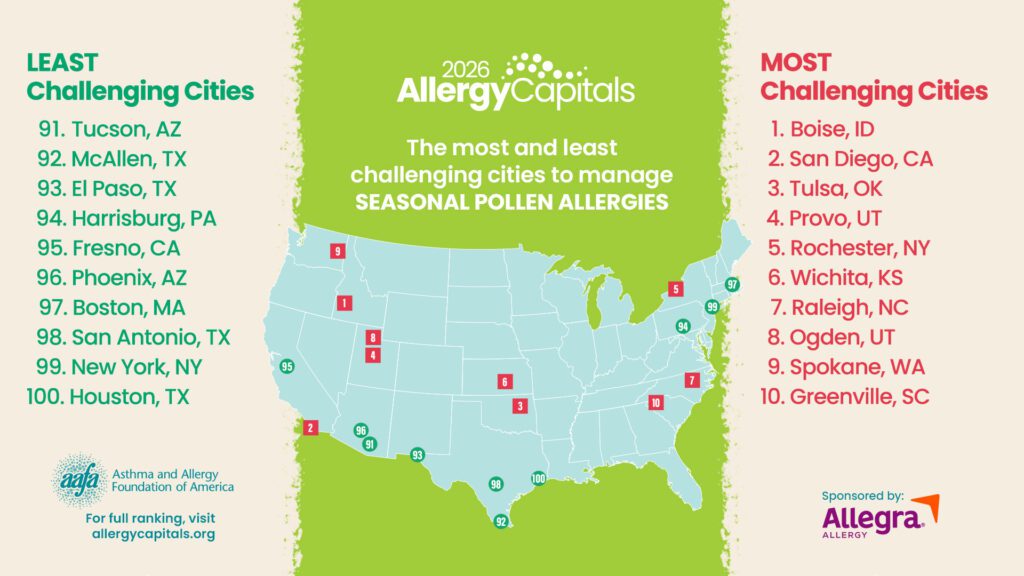
This year, Boise, Idaho, claimed the top spot due to higher-than-average pollen levels and relatively low availability of allergy specialists. Boise moved into the top spot due to tree pollen peaking earlier and lasting longer as well as a significant increase in the number of days with “high” or “very high” grass pollen. The effects of climate change helped drive Boise’s climb to the top of the rankings.
“Allergies disrupt sleep, undermine concentration, keep children home from school, and keep adults from work. We are experiencing a widening health threat fueled by climate change,” said Kenneth Mendez, President and CEO of AAFA. “Millions of people in the U.S. live with seasonal pollen allergies, and extreme weather events driven by climate change contribute to the conditions that lead to higher pollen levels and longer allergy seasons. This report is a call to action for policymakers: We need climate solutions, and we need them now.”
The report’s data paints a devastating picture of the current climate reality. Extreme weather events – including atmospheric rivers, warmer temperatures, and drought – are becoming more common. These events help create the conditions for longer, more intense pollen seasons, meaning many people in the U.S. experience nearly year-round exposure to some type of pollen.
AAFA’s Allergy Capitals ranking scores the top 100 most populated city areas in the contiguous United States based on annual pollen counts, over-the-counter allergy medicine use, and number of allergists. The full report can be found at allergycapitals.org
The top 20 Allergy Capitals® for 2026 (out of 100 cities ranked) are:
1. Boise, ID
2. San Diego, CA
3. Tulsa, OK
4. Provo, UT
5. Rochester, NY
6. Wichita, KS
7. Raleigh, NC
8. Ogden, UT
9. Spokane, WA
10. Greenville, SC
11. San Francisco, CA
12. Minneapolis, MN
13. Salt Lake City, UT
14. Richmond, VA
15. Colorado Springs, CO
16. Little Rock, AR
17. Toledo, OH
18. New Orleans, LA
19. Winston-Salem, NC
20. Lakeland, FL
The impact of longer, more intense pollen seasons goes beyond simply more sneezing. Pollen is a common trigger of allergic asthma, allergic rhinitis, allergic conjunctivitis, atopic dermatitis, nasal polyps, and eosinophilic esophagitis.
“Long and potent pollen seasons make managing allergies and asthma more challenging, leading to increased health care costs and missed days of school and work,” said AAFA Chief Mission Officer Melanie Carver. “At the individual level, allergy management strategies will help reduce symptoms. But long-term and wide-scale solutions require policymakers at all levels of government to adopt strategies to address the climate and health crisis.”
AAFA’s Allergy Capitals report includes both strategies for allergy management and recommendations for policymakers.
“Monitoring pollen counts is a key strategy in managing pollen allergy,” said Kris Klein, CEO of Pollen Sense. “When you are aware of pollen levels, you can make an informed decision about time spent outdoors. Pollen Sense is proud to work with AAFA in support of this annual report. As extreme weather events bring high pollen counts to more parts of the country, it is critical that communities understand the impact of pollen. This report provides both tools for understanding pollen allergies and actionable insight to promote policy change.”
The 2026 Allergy Capitals report is an independent research project of the Asthma and Allergy Foundation of America and made possible by support from Opella, makers of Allegra®.
Resources:
- 2026 Allergy Capitals® report: allergycapitals.org
- Allergy facts and stats: aafa.org/allergyfacts
- Pollen allergy: aafa.org/pollen
- Allergy medicine guide: aafa.org/allergymeds
Press Contact:
Andy Spears
Public Affairs Manager
Asthma and Allergy Foundation of America (AAFA)
gro.afaa@aidem
About the Research
The 2026 Allergy Capitals® research and ranking is reported by the Asthma and Allergy Foundation of America (AAFA). The ranking is based on analysis of data from the 100 most-populated Metropolitan Statistical Areas (MSAs) in the contiguous 48 states as determined by the most recent U.S. Census Bureau population estimates (2024). The individual factors analyzed for the 2026 rankings are pollen scores for tree, grass, and weed pollen, over-the-counter medication use (allergy), and number of allergy specialists.
For each factor, AAFA used the most recently available 12-month data. Weights are applied to each factor; factors are not weighted equally. Total scores are calculated as a composite of all four factors, and cities are ranked from highest total score (city rank #1) to lowest total score (city rank #100). Cities are assigned icons for ■ worse than average, ▲ average, and ● better than average. Icons were assigned based on 0.5 standard deviation from the average.
About AAFA
Founded in 1953, AAFA is the oldest and largest non-profit patient organization dedicated to saving lives and improving the quality of life for people affected by asthma and allergic diseases through support, advocacy, education, and research. AAFA offers extensive support for individuals and families affected by asthma and allergic diseases, such as food allergies and atopic dermatitis (eczema). Through its online patient support communities, network of regional chapters, and collaborations with community-based groups, AAFA empowers patients and their families by providing practical, evidence-based information and community programs and services. AAFA is the first asthma and allergy patient advocacy group certified to meet the standards of excellence set by the National Health Council. For more information, visit: aafa.org and kidswithfoodallergies.org