









Asthma
Chronic Obstructive Pulmonary Disease (COPD)
COPD refers to two main conditions that can make it harder to breathe: chronic bronchitis and emphysema. Most people with COPD have a mix of these conditions. The symptoms are similar to asthma.1,2
COPD is preventable and treatable. COPD is currently the third most common cause of death worldwide.1
Smoking is the main cause of COPD in developed countries like the United States. Smokers and former smokers are at greater risk of having asthma and COPD.
It is important to make a proper diagnosis of asthma and/or COPD because treatment can differ. COPD is usually managed with bronchodilators [brahn-ko-DIE-ah-lay-tors], inhaled corticosteroids [kor-tick-OH-stair-ROIDS], and lifestyle management.1,3,4
What Is COPD?
COPD is an umbrella term for lung diseases with progressive airway damage that causes airflow blockage and breathing problems. COPD is preventable and treatable, although currently not curable. COPD includes chronic bronchitis [brawn-KIE-tis] and emphysema [em-fuh-ZEE-muh]. COPD is associated with lung changes due to chronic inflammation, including:1,2
- Inflammation, scarring, thickening, and narrowing of the airways
- Loss of airway elasticity (which makes it harder for the airways to stretch and recoil during breathing)
- Enlarged and damaged alveoli [al-VEE-oh-lie] (the air sacs in your lungs)
- Thick mucus
People with COPD often have features of both chronic bronchitis and emphysema. Emphysema causes damage to and enlarges the alveoli, and its most common symptom is shortness of breath (dyspnea). Chronic bronchitis is long-term inflammation in the large airways that causes narrowing and excessive production of mucus. Cough is the most common symptom of chronic bronchitis.2
COPD is currently the third most common cause of death worldwide. Anyone can develop COPD, but it primarily affects smokers and people older than 40 years.1
What Causes COPD?
COPD is mainly caused by prolonged exposure to harmful agents, with cigarette smoking being the main cause of COPD in developed countries. Other causes are secondhand smoke, and environmental or work exposure to airborne toxins, pollutants, dust, and fumes. COPD can also be caused by alpha-1 antitrypsin deficiency, a genetic disorder that can lead to lung damage.1,2
What Are the Symptoms and Signs of COPD?
Symptoms of COPD include:1,2
- Long-term cough with mucus (sputum) production (for three months or longer at a time for at least two years)
- Difficulty taking a deep breath
- Chronic and progressive shortness of breath (dyspnea), occurring especially when performing daily activities or with mild exertion
- Wheezing or other lung sounds
- Chest tightness
- Barrel-shaped chest
- Cyanosis, a tissue color change on mucus membranes (tongue, lips, around the eyes) and fingertips or nail beds – the color appears grayish or whitish on darker skin tones and bluish on lighter skin tones
How Do Doctors Diagnose COPD?
If you have relevant symptoms and risk factors, then you should be evaluated for COPD. To diagnose COPD, your doctor will do a physical exam. They will ask you questions about your symptoms, your personal and family medical history, previous exposure to pollutants, and your habits. Your doctor may also ask you if you smoke or smoked in the past, and how you feel when doing exercise.1,2
The diagnosis is confirmed by spirometry (a lung function test). Spirometry is essential in the diagnosis, staging, and monitoring of COPD. It measures how much air you exhale and the amount you can force out in the first second. This is known as FEV1/FVC ratio. A low ratio can confirm if you have COPD.1,2
Other COPD tests may include a 6-minute walk test, laboratory testing, oxygen measure tests, an electrocardiogram, radiographic imaging (such as chest X-rays or computer tomography [CT] scans), and blood tests to see if you might have alpha-1 antitrypsin deficiency.1,2
How Can You Tell the Difference Between Asthma and COPD?
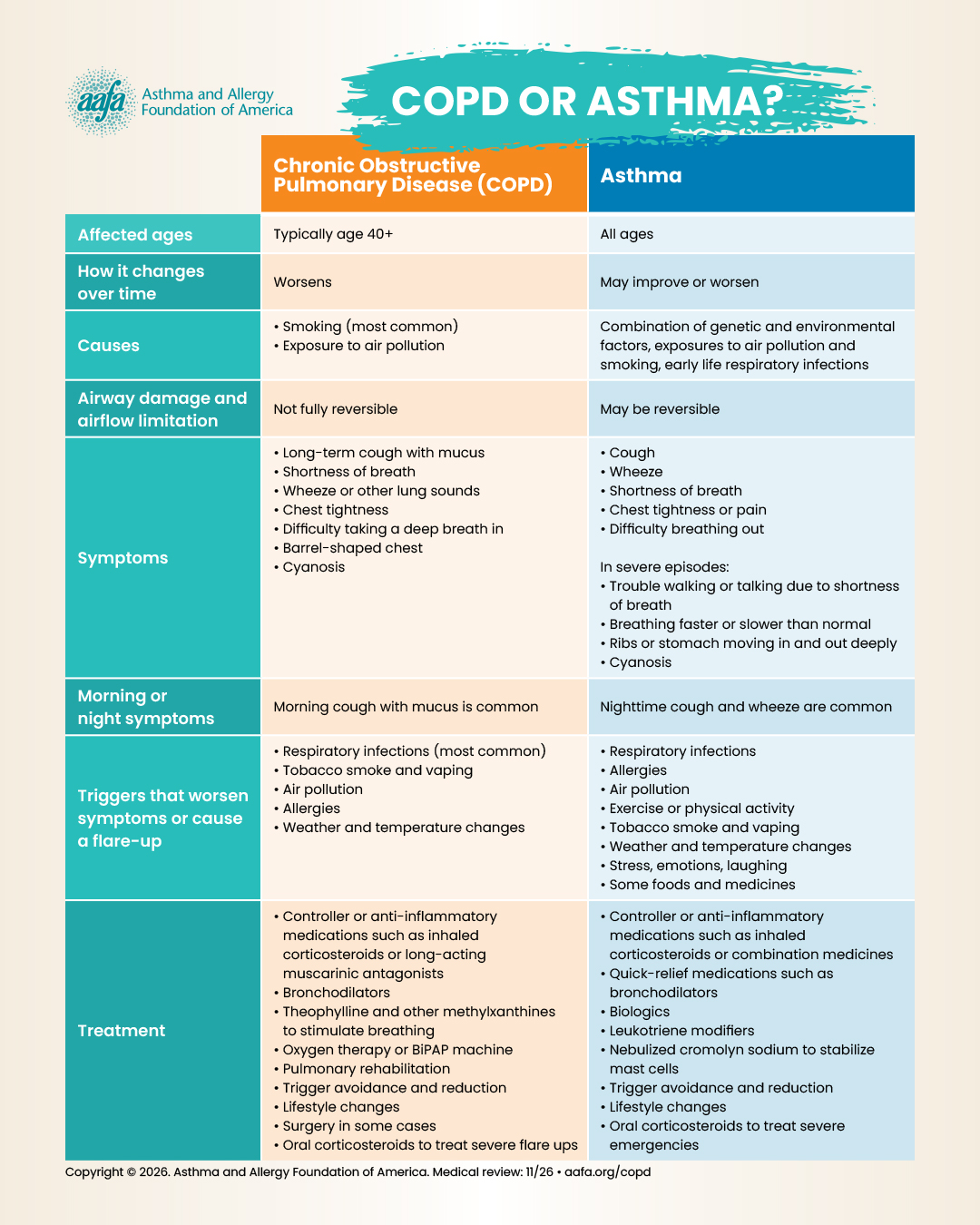
COPD and asthma may be difficult to tell apart because they share common symptoms such as shortness of breath, wheezing, and cough. The treatment and management plans for the two conditions are different. Your doctor should be able to determine which of these diseases is affecting you based on your symptoms, medical history, and the results of physical and medical exams.3,4
There are differences between COPD and asthma:
- COPD is a progressive disease which means it steadily worsens over time. COPD is caused by breathing in harmful substances over a long period of time with ongoing symptoms that are present all the time. Aggravation or worsening of COPD symptoms may occur (called a flare-up or exacerbation), with the main trigger being respiratory infections. The airflow limitation caused by COPD is not fully reversible. A daily morning cough that produces thick mucus is particularly characteristic of COPD, namely chronic bronchitis. Also, COPD is usually associated with a long history of smoking and people older than 40 years.3,4,5
- Asthma usually has a variable course. The airflow limitation caused by asthma is often reversible either spontaneously or with treatment. Its symptoms typically occur as mild to severe asthma episodes, also called an asthma flare-up or asthma attack, and between these attacks breathing may return to normal. Episodes of wheezing and night chest tightness are more common with asthma than with COPD. People with asthma are more likely to have allergies such as hay fever or eczema. Asthma attacks can be triggered by allergies, cold air, exercise, respiratory infections, pollution, or stress. Asthma has a better response to medications such as bronchodilators and corticosteroids than COPD.3,4,5
What Is Asthma-COPD Overlap (ACO)?
It is possible for a person to have both asthma and COPD. This is called asthma-COPD overlap (ACO). The causes of ACO are usually a combination of both COPD and asthma causes, including cigarette smoking and environmental factors. People with ACO usually have a combination of asthma and COPD symptoms, including cough, mucus production, shortness of breath, and wheezing. People with ACO tend to have more flare ups, emergency department visits, and hospital admissions than people with asthma or COPD alone.6
What Is the Treatment for COPD?
There currently is no cure for COPD, and the main goals of treatment are to control symptoms, improve quality of life, and reduce exacerbations1,2
Common medications used in COPD include inhaled corticosteroids, and inhaled bronchodilators, such as beta2-agonists and antimuscarinics:1
- Inhaled beta2-agonists relax the smooth muscle in the airways, widening them. Short-acting beta2-agonists (SABAs) and long-acting beta2-agonists (LABAs) are commonly used in COPD treatment. SABAs are used as needed to provide quick relief of symptoms, while LABAs are typically used as controller medicine.
- Inhaled antimuscarinics work by preventing the constriction and closing of the airways. Short-acting antimuscarinic agents (SAMAs) like SABAs provide a quick relief of symptoms and are used on an as-needed basis. Long-acting antimuscarinic agents (LAMAs), like LABAs, are used as controller medicine.
Inhaled corticosteroids are often used in combination with LABAs and LAMAs to decrease inflammation. Methylxanthines, a type of drug that stimulates breathing, are also used in maintenance therapy, usually after LABA or LAMA treatment.1,2 Other forms of treatment include oxygen therapy, pulmonary rehabilitation, lifestyle changes, and in some cases, surgery.
Your doctor may also recommend to you:1,2
- Quit smoking, e.g., by means of a smoking cessation program
- A pulmonary rehabilitation program, which includes a comprehensive exercise, health education, and lifestyle plan
- Oral corticosteroids, reserved for the management of acute exacerbations
- Oxygen therapies, to increase your oxygen levels
- Positive airway pressure, e.g., by using a BiPAP machine to help you breathe better
- Antibiotics, to prevent bacterial infections
- Lung volume reduction, a surgery or a valve procedure that reduces the air trapped in your lungs for good candidates with severe COPD
- Clinical trials, tests of new treatments to see if they’re safe and effective
Other strategies to prevent or to slow down the progression of COPD include:1
- Avoiding second-hand smoke exposure
- Reducing occupational/environmental exposure to other harmful agents, such as asbestos, beryllium, carbon dust, silica, chromium, fungi, avian droppings, bacterial species, and unvented coal stoves
- Education on proper inhaler use and its importance
- Complying with follow-up and the treatment plan
- Detection of worsening symptoms
- Proper diet
People with COPD have an increased risk of getting respiratory infections. These can lead to pneumonia and severe exacerbations of COPD symptoms. Additional strategies to reduce the risk of infections include:2
- Keeping up with all recommended vaccines, including flu, pneumococcal pneumonia, and COVID-19
- Washing your hands regularly
- Disinfecting surfaces
- Wearing a mask when recommended
- Avoiding crowded places, especially during cold and flu season and when cases of COVID are high
For people with ACO, inhaled corticosteroids and bronchodilators are the preferential treatments. Other strategies such as vaccination, smoking cessation, and avoiding exposure to other sources of smoke are also helpful to manage ACO.6
Medical Review: October 2026 by Med Communications, Inc. and the COPD Foundation assisted with development and review of medical content.
Editorial Review: November 2026 by Melanie Carver, AAFA Chief Mission Officer.
For more information on COPD, visit the COPD Foundation at: copdfoundation.org

Closed
References
- Agarwal A. K., Raja A., & Brown B. D. (2026, April 15). Chronic Obstructive Pulmonary Disease. In StatPearls. StatPearls Publishing. Retrieved September 16, 2026, from: https://www.ncbi.nlm.nih.gov/books/NBK559281/
- Cleveland Clinic. (2024, August 19). Chronic Obstructive Pulmonary Disease (COPD). My Cleveland Clinic. Retrieved September 16, 2026, from: https://my.clevelandclinic.org/health/diseases/8709-chronic-obstructive-pulmonary-disease-copd
- American Academy of Allergy Asthma & Immunology. (2026, April 8). Asthma and COPD: Differences and Similarities. Retrieved September 16, 2026, from: https://www.aaaai.org/tools-for-the-public/conditions-library/asthma/asthma-and-copd-differences-and-similarities
- Cleveland Clinic. (2024, January 10). Understanding the Difference Between Asthma and COPD. Cleveland Clinic. Retrieved September 16, 2026, from: https://health.clevelandclinic.org/asthma-vs-copd
- Cukic V., Lovre V., Dragisic D., & Ustamujic A. (2012). Asthma and Chronic Obstructive Pulmonary Disease (COPD) – Differences and Similarities. Materia Socio Medica, 24(2), 100-105. https://doi.org/10.5455/msm.2012.24.100-105
- Awad M. T., & Sankari A. (2023, June 11). Asthma and COPD Overlap. In StatPearls. StatPearls Publishing. Retrieved September 16, 2026, from: https://www.ncbi.nlm.nih.gov/books/NBK592422/

Knowing how to manage asthma is important for better health and quality of life. We offer an online course called ASTHMA Care for Adults. This comprehensive program covers a full range of topics everyone with asthma needs to know. This self-paced online course is presented in different formats, such as videos, animations, handouts and more.