






Asthma
Nasal Polyps
Nasal polyps are small growths on the lining inside the nose or sinus cavities. They are not cancer. They are shaped like hanging grapes or teardrops. Nasal polyps are usually soft and painless. They can be in both sides of the nasal cavity. Also, they can usually be identified as different from normal nasal tissue.
You may develop nasal polyps from chronic (long-term) inflammation and swelling in your sinuses. People with respiratory diseases, such as asthma, chronic rhinosinusitis, or aspirin-exacerbated respiratory disease (AERD), have a greater chance of having nasal polyps. This is called chronic rhinosinusitis with nasal polyps (CRSwNP).
If you do not get treatment for nasal polyps, they can cause long-term problems in your nose and sinuses. This can have a major impact on your quality of life and mental health.
What Are the Symptoms of Nasal Polyps?
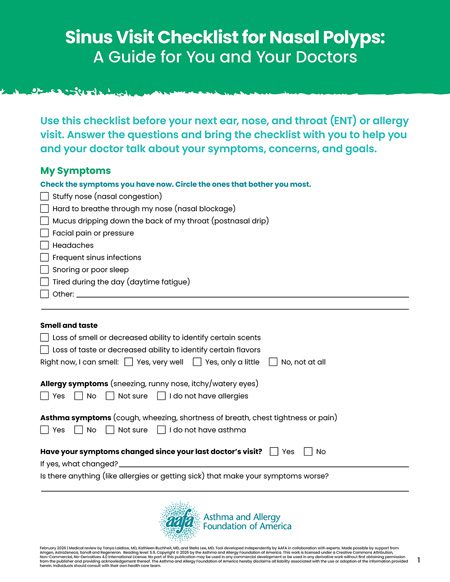
Symptoms may be different for each person and may vary depending on your age. Common symptoms of nasal polyps may include:
- Runny nose
- Stuffy nose (congestion), fullness, blockage within the nose (most common symptom)
- Trouble breathing through the nose
- Postnasal drip (sometimes causing cough and throat irritation)
- Loss of or decreased sense of smell and taste
- Headaches
- Pressure or pain on your face or in your sinuses
- Pain in your upper teeth
- Snoring, trouble sleeping, and breathing through your mouth at night
Who Is at Risk of Getting Nasal Polyps?
As many 4% of people in the United States have nasal polyps. They mainly affect adults over 20 years old and are uncommon in children under 10 years old.1 Nasal polyps are 2 times more common in males, but females who develop nasal polyps usually have more severe cases.2
Experts don’t fully understand what causes nasal polyps. But they have found that certain conditions may play a part in developing nasal polyps. They include:
- An increase in a type of immune cell called an eosinophil [EE-oh-sin-oh-FILL]
- Certain types of infections, especially a type of staph bacterial infection
- Damaged nasal and sinus thin tissue – this may increase your exposure to airborne viruses, allergens, and particles in the environment and can lead to long-term inflammation (swelling)
You may be at a higher risk of getting nasal polyps if you have:
- History of allergies
- Recurring sinus infections
- Nasal trauma (nose injuries)
- Past nasal surgery
- Long-term exposure to poor air quality or allergens such as pets
- Family history of nasal polyps
How Do Doctors Diagnose Nasal Polyps?
Your doctor can make a diagnosis by asking questions about your medical and family history, your specific symptoms and doing a physical exam. This may include an exam of your nose with the help of a lighted instrument. Your doctor may also run other tests, such as:
- Nasal endoscopy (a scope or narrow tube with tiny camera up your nose)
- Imaging scans of the sinuses (a sinus CT scan is ideal, if possible – X-rays of the sinuses are not generally recommended)
- Allergy tests to rule out specific allergies
- Blood tests to rule out specific allergies and immune problems
- Rarely, a look at airflow and biopsies of the sinuses
If you have nasal polyps, you may see a team of doctors. They can include:
- Primary care physician (PCP)
- Ear, nose, and throat (ENT) specialist
- Allergist/immunologist
- Sinus surgeon (ENT or neurosurgeon)
What Treatments Are Available for Nasal Polyps?
There are several treatments to help you manage nasal polyps. Talk with your doctor to decide which treatments are best for you.
Nasal corticosteroids are often one of the first medicines used to treat nasal polyps. They reduce swelling and inflammation to shrink the polyps. But they may not reach deep enough into the nasal cavity to be as effective as they need to be. Common nasal corticosteroid sprays include:
- Fluticasone (brand example: FLONASE)
- Budesonide (brand example: RHINOCORT®)
- Mometasone (brand example: Nasonex™)
- Triamcinolone (brand example: Nasacort®)
- Beclomethasone (brand example: BECONASE AQ®)
- Ciclesonide (brand example: OMNARIS®)
If a nasal corticosteroid doesn’t work, your doctor may suggest a short-term oral corticosteroid, such as prednisone. They may prescribe it alone or in combination with a nasal spray. If your nasal polyps are severe, they may recommend an injectable corticosteroid.
Be aware that using oral or systemic (treats your entire body) corticosteroids often or for a long time can cause major side effects. Talk with your doctor about the benefits and risks.
Use a saline (saltwater) nose rinse to remove irritants and allergens from your nose. This is a safe and inexpensive option that can improve nasal congestion. The water should be high volume but low pressure. Doing a nasal rinse before using a topical medicine nasal spray can help the medicine reach the tissue in your nose.
Biologics are treatments that target a certain cell or protein to prevent swelling and inflammation inside the airways. They are not steroids. They are given by injection or infusion. Your doctor may prescribe a biologic if other medicines aren’t working.
As of July 2024, there are 3 biologics (approved by the FDA) to treat chronic sinusitis with nasal polyps:
- Dupilumab (DUPIXENT®)
- Mepolizumab (Nucala)
- Omalizumab (XOLAIR®)
People with asthma are more likely to have chronic rhinosinusitis and nasal polyps.
For more severe cases, surgery may be the best choice. This may happen when polyps do not respond to medical treatments. Surgery can be done by an ENT specialist to remove nasal polyps. This is most often done on an outpatient surgical center. This means you don’t have to stay in the hospital to recover.
During the surgery, the surgeon inserts a small tube with a lighted magnifying lens (called a tiny camera endoscope) into your sinuses. The surgeon then removes the polyps with small instruments. The surgeon may also make the openings from your nasal cavities to your sinuses larger.
How Can I Manage Nasal Polyps and Stop Them from Coming Back?
If you have surgery to remove nasal polyps, take proper care of your sinuses to stop them from coming back. Take these steps to prevent nasal polyps from returning:
- Use a saline nasal spray or rinse to keep your nasal passages moist and prevent swelling. If you have nasal allergies, it can also flush allergens, such as pollen, from your nose.
- Use a nasal corticosteroid spray to reduce swelling.
- Keep your asthma and allergies well-controlled. People with asthma and allergies have a higher chance of developing nasal polyps.
- Reduce your exposure to irritants (such as air pollutants, smoke, dust, chemicals) and your allergy triggers (such as pollen, animal dander, mold, dust mites) as much as possible. Use Certified Asthma & Allergy Friendly® products to help you have a healthier home.
- If the air in your home is dry, use a humidifier. Dry air can dry out your nose. Moist air can help improve the flow of mucus and prevent swelling. Try to keep your home between 30 and 50%, if possible. Dust mites and molds (both common allergens and irritants) thrive in humidity over 50%.
- Wash your hands often with warm water for at least 20 seconds. This can reduce your chance of getting an infection from bacteria or a virus that could cause swelling in your nose and sinuses.
Nasal Polyps Educational Webinars
Learn more about nasal polyps signs and symptoms, management, treatment options, and resources. Don’t miss our full suite of nasal polyps educational webinars for patients and caregivers.
Medical Review: July 2024 by John James, MD
Closed
Drug Company Assistance Programs
The medicines covered by the programs below may change at any time. The following medicines are covered as of Jan. 24, 2025.
Company:
- AstraZeneca
Medicines offered:
- AIRSUPRA®
If you have commercial insurance: If you have employer-provided or individual private (commercial) insurance, you may be able to get AIRSUPRA for as low as $0 with the SUPRA Savings Card.
If you have government insurance: For people with Medicare Part D coverage, the average out-of-pocket cost is $89 per month. For people with Medicaid, the out-of-pocket costs range from $.99-$13 per month. Some states offer even lower copays or eliminate the copay altogether. If you have Medicare Part D and cannot afford AIRSUPRA, you may be eligible for the patient assistance program, AZ&Me.
If you have no insurance: If you do not have health insurance or your insurance does not cover AIRSUPRA, you will pay the amount determined by your pharmacy. You may also be eligible for the patient assistance program, AZ&Me.
Learn more on the Cost Assistance with AIRSUPRA website or call 866-480-0030.
Company:
- AstraZeneca
Medicines offered:
- BEVESPI AEROSPHERE®
- BREZTRI AEROSPHERE®
- SYMBICORT®
- FASENRA®
- TEZSPIRE®
If you have commercial insurance, government insurance, or no insurance:
AstraZeneca US Patient Support offers various savings for several of their medicines. They offer copay savings cards and patient assistance programs depending on what type of insurance you have.
For more information, visit AZPatientSupport or call 800-236-9933.
AstraZeneca has capped the cost of their inhalers to $35 if you have commercial or private insurance. Learn more about the price cap.
Company:
- AstraZeneca
Medicines offered:
- TEZSPIRE®
If you have commercial insurance: The TEZSPIRE Together Co-Pay Program can help may help you save regardless of income if you qualify. Get doses for as little as $0 and up to $100 off your in-office administration costs (pre-filled syringe only). Learn more on the TEZSPIRE Together Co-Pay Program website or call 888-987-7473.
If you have government insurance: The TEZSPIRE Together Program, you may be able receive TEZSPIRE at no cost if you qualify. This includes people who:
- Are uninsured
- Have Medicare Part B with no supplemental insurance
- Have a Medicare Advantage plan with an affordability gap
- Have insurance that does not cover TEZSPIRE
For more information, call 888-987-7473.
Company:
- Boehringer Ingelheim
Medicines offered:
- Atrovent® HFA
- Combivent® Respimat®
- Spiriva® Respimat®
- Stiolto® Respimat®
- Striverdi® Respimat®
If you have commercial insurance or don’t have insurance: If you qualify, your cost will automatically be discounted when you buy these inhalers at participating retail pharmacies. If your cost is more than $35, download and use a savings card. Learn more at: InhalerOffer.com
If you have government-funded insurance: If you use Medicare, Medicaid, CHIP, or TRICARE, visit the Boehinger Cares Patient Assistance Program webpage or call 800-556-8317 to apply for assistance.
Boehringer Ingelheim has capped the cost of their inhalers to $35 if you have commercial or private insurance. Learn more about the price cap.
Company:
- Sanofi and Regeneron Pharmaceuticals, Inc.
Medicines offered:
- DUPIXENT®
If you have commercial insurance: The Dupixent MyWay® Copay Card may help you lower the cost of your copay. Learn more on the Dupixent MyWay Copay Card website or call 844-DUPIXENT (844-387-4936), option 1.
If you don't have insurance or your insurance doesn’t cover Dupixent: You can apply for the DUPIXENT MyWay Patient Assistance Program. For more information or to sign up, call 844-DUPIXENT (844-387-4936), option 1.
If you have Medicare: At this time, there is not a savings program for Dupixent if you have Medicare. Call 844-DUPIXENT (844-387-4936), option 1 for more information.
If you have Medicaid: Your copay and coverage may vary depending on what state you live in. If you meet the criteria, you may also be able to get help from the DUPIXENT MyWay Patient Assistance Program. For more information or to sign up, call 844-DUPIXENT (844-387-4936), option 1.
Medicines covered:
- Epinephrine devices – all brands
Savings programs:
- See AAFA’s list of all available epinephrine devices and their patient assistance programs.
Company:
- Genentech
Medicines offered:
- Xolair®
If you have commercial insurance: Genentech offers a copay savings program for Xolair. You may also be able to get help from an independent copay assistance foundation. ![]()
If you have government insurance or don’t have insurance: You may be able to get help from an independent copay assistance foundation. Find programs. ![]()
Company:
- GSK (GlaxoSmithKline)
Medicines offered:
- ARNUITY ELIPTA
- ANORO ELLIPTA
- BREO ELLIPTA
- INCRUSE ELLIPTA
- NUCALA®
- SEREVENT®
- TRELEGY®
If you have commercial insurance: You may be eligible for the GSK Copay Assistance Program.
If you have Medicare or no insurance: You may qualify for the GSK Patient Assistance Program. This program can help you receive certain GSK prescription medicines and vaccines at no cost.
For more information, visit GSK Patient Assistance Program & Savings Offers or call 888-825-5249.
GSK has capped the cost of their inhalers to $35 if you have commercial or private insurance. Learn more about the price cap.
Company:
- GSK (GlaxoSmithKline)
Medicines offered:
- NUCALA®
If you have commercial insurance: If you have a commercial medical or prescription insurance plan, you may be able to take part on the NUCALA Copay Program. If you are approved, the GSK Copay Program may help with your cost share for NUCALA and the your cost share for administration up to the total annual copay program maximums.
If you have government insurance or no insurance: You are not eligible for this program if you are covered by any federal or state prescription insurance program.
For more information, visit the NUCALA Copay Program website or call 800-691-1939.
Company:
- Organon
Medicines offered:
- ASMANEX® HFA
- ASMANEX® TWISTHALER®
- DULERA®
If you have commercial insurance: If you qualify, you may be able to save with an ASMANEX Multiuse Savings Coupon.
If you qualify, you may pay as little as $15 per Dulera prescription on each of up to 12 qualifying prescriptions. The maximum savings is $90 per prescription.
If you have government insurance or no insurance: At this time, there is no assistance program if you have Medicaid or Medicare.
Company:
- Teva
Medicines Covered:
- QVAR RediHaler®
- CINQAIR®
Teva Cares Patient Assistance Program provides certain Teva medicines at no cost if you live in the United States and meet specific insurance and income criteria. Learn more about program eligibility.
If you do not meet the eligibility requirements for the Teva Cares Foundation Patient Assistance Programs, you may be eligible for help from other programs they offer.
For more information, visit the Teva Cares Foundation website or call 888-838-2872.
Pharmacy Drug Savings Programs
Program Name:
Contact Information:
- 844-265-6444
- moc.htlaehknilb@ofni
About the Program:
- Blink Health finds the lowest price for the medicines you need. Find discounted prescription prices on more than 15,000 medicines.
Program Name:
Contact Information:
- 844-926-2480
- moc.xrknilb@troppus
About the Program:
- BlinkRx is a digital pharmacy service that carries certain medicines. They can provide the lowest prescription price while providing free home delivery.
Program Name:
Contact Information:
- 855-268-2822
About the Program:
- GoodRx is a free resource that lets you compare medicine prices and find discounts.
Looking for savings on asthma inhalers? See the GoodRx Savings Guide for ways you may be able to save money on 25 asthma inhalers.
Program Name:
Contact Information:
- 833-317-2937
About the Program:
- The Kroger Health Savings Club is an annual membership program that entitles members to reduced prices on prescription drugs.
Program Name:
Contact Information:
About the Program:
- Mark Cuban CostPlus Drug Company offers access to affordable medicines at the lowest possible price. Learn about program eligibility.
Program Name:
Contact Information:
- 888-331-1002
About the Program:
- The SCBN Prescription Assistance program is for uninsured or underinsured people who cannot afford their prescribed medicines.
- The program requires a membership fee to participate.
Program Name:
Contact Information:
- Contact your local Walmart pharmacy
About the Program:
- The Walmart low-cost Prescription Program includes up to a 30-day supply for $4 and a 90-day supply for $10 of some covered generic drugs at commonly prescribed dosages. Prices for some drugs covered by the program may vary by state.
Program Name:
Contact Information:
- 877-296-4673
About the Program:
- Prescription Hope provides access to brand-name medicines for only $60 a month per medication through their medication access service. Learn about program eligibility.
Nonprofit Copay and Premium Assistance Programs
Organization:
Contact Information:
- 800-511-5144 (TTY 711)
- moc.htlaehairaca@eracremotsuc
About the Program:
- AcariaHealth provides specialty pharmacy services for people living with complex and chronic health conditions. Their Copay Assistance Support Team will research and apply to qualifying patient assistance programs on behalf of the patient. Learn about the program.
Organization:
Contact Information:
- 800-366-7741
About the Program:
- Accessia Health provides financial help to pay for copays, health insurance premiums, travel costs, and other medical expenses. Learn about program eligibility.
Organization:
Contact Information:
- 877-968-7233
About the Program:
- Good Days provides financial support for people who cannot afford the treatment they urgently need.
- Copay, travel, premium, and diagnostic testing assistance may be available.
- Learn about eligibility criteria.
Organization:
Contact Information:
- 980-859-3483
- gro.htaprobrah@ofni
About the Program:
- Harbor Path delivers lifesaving medicine for free to people who are uninsured. They currently serve 24 states. Use the eligibility calculator to see if you qualify.
Organization:
Contact Information:
- 800-675-8416
- gro.noitadnuofllewhtlaeh@stnarg
About the Program:
- HealthWell Foundation provide financial assistance to help with prescription copays, travel costs, behavioral health services, health insurance premiums, deductibles, and copays. Please note that diseases covered may change from time to time.
Organization:
Contact Information:
- 866-316-7263
About the Program:
- The PAN Foundation offers financial help for out-of-pocket medicine costs including copays, health insurance premiums, and transportation costs related to medical care. Learn about program eligibility. Please note that diseases covered may change from time to time.
Organization:
Contact Information:
- 866-512-3861
About the Program:
- PAF’s Co-Pay Relief (CPR) program provides direct financial help to qualified people with co-payments, co-insurance or cost-sharing associated with prescription drugs through funds for specific disease states. Learn about program eligibility. Please note that diseases covered may change from time to time.
Organization:
Contact Information:
- 800-769-3880
About the Program:
- Rx Outreach provides discounted medicines for eligible people. Learn about the program.
Organization:
Contact Information:
- 855-845-3663
About the Program:
- TAF helps people and families by providing them with financial help for their copays, coinsurance, premiums, deductibles, and other health-related expenses.
Patient Assistance Tools and Databases
Tool:
- BenefitsCheckUp® – National Council on Aging
Contact Information:
- 800-794-6559
More Information:
- BenefitsCheckUp® is a free service of the National Council on Aging (NCOA). It is an online tool to connect older adults and people with disabilities to benefit programs such as health care, medicine, food, utilities, and more.
Tool:
Contact Information:
- 615-736-5075
- gro.epohfoyrasnepsid@ofni
About the Program:
- Dispensary of Hope provides medicine to communities, free of cost. They are a charitable medication distributor dedicated to providing pharmacies and clinics with reliable access to medication that was generously donated by pharmaceutical manufacturers. Find a dispensing site near you, here.
Tool:
Contact Information:
- 800-503-6897
- gro.sdemydeen@ofni
More Information:
- A national nonprofit that connects people to programs that may help them afford their medicines and other health care costs.
Tool:
- PhRMA’s Medicine Assistance Tool (MAT) – Partnership for Prescription Assistance
Contact Information:
- 571-350-8643
More Information:
- PhRMA’s Medicine Assistance Tool (MAT) is a search engine for many patient assistance resources offered by drug makers.
Tool:
Contact Information:
More Information:
- RxAssist offers a comprehensive database of patient assistance programs. Learn about the eligibility requirements.
Tool:
Contact Information:
- 844-234-3057
- moc.eracelgnis@troppus
More Information:
- SingleCare works with pharmacies on discounts on prescriptions. Look up prescriptions to find the lowest prices in your area.
Tool:
Contact Information:
- 800-719-5147
- moc.esnesxr@rednifsgnivasxr
About the Program:
- Walgreens Rx Savings Finder can help you find prescription discount cards that can help you find the lowest price on a medicine at Walgreens.
State Drug Assistance Programs
Organization:
- Extra Help – Social Security Administration
Contact Information:
- 800-772-1213
- (TTY 800-325-0778)
More Information:
- The Extra Help program helps people with limited income and resources lower or cut Medicare Part D costs.
Organization:
- State Health Insurance Assistance Programs (SHIPs) – National Technical Assistance Center
Contact Information:
- 877-839-2675
- gro.htlaehpihs@ofni
More Information:
- Free insurance counseling and help to Medicare-eligible people, their families, and caregivers.
Organization:
Contact Information:
- Contact your local county office.
More Information:
- CalAIM offers people on Medi-Cal access to services that address physical, behavioral, developmental, dental, and long-term care needs.
Organization:
- State Pharmaceutical Assistance Program – Medicare.gov
More Information:
- Find out if your state has a state pharmaceutical assistance program.
Organization:
- Pharmaceutical Assistance Program – Medicare.gov
More Information:
- Learn more about pharmaceutical companies that offer programs to help pay for prescriptions for people with a Medicare Drug Plan (Part D).
Community Resources
American Sleep Apnea Association: Assists people with sleep apnea who cannot afford their CPAP mask supplies through the CPAP Assistance Program.
Friends of Man: Receives applications for mobility equipment, prosthetics, home modifications, medical equipment, hearing aids, basic needs and much more. The referral must be made by a professional. This includes caseworkers, case managers, health care workers, social workers, school counselors, teachers, and clergy.
FoodFinder: A map of food pantries across the United States. Search your ZIP code to learn about free food assistance programs near you.
FundFinder: Helps you find financial assistance from charitable foundations.
Inspira Financial: Funds in a health savings account (HSA) or a health care flexible spending account (FSA) can be used for eligible medical expenses.
Society of St. Vincent de Paul: A national non-profit that provides local assistance and services.
United Way 211: The most comprehensive source of information about local resources and services in the country.
AAFA Regional Chapters
The AAFA New England Chapter has more information on drug assistance for Massachusetts residents.
The AAFA Michigan Chapter has more information on drug assistance for Michigan residents, including the Jared Williams Medication Fund (JWMF).


