







Allergies
Dust Mite Allergy
If you have allergies or asthma, tiny creatures living in your home could be causing symptoms. Although you can’t see them, these dust mites are one of the most common triggers of year-round allergies and allergic asthma.
Dust mites live in nearly every home (except in very dry or high-altitude places), no matter how clean. It may not be possible to rid your home entirely of these creatures. But there are ways you can reduce them and manage your dust mite allergy.
On this page:
What is a dust mite allergy?
What do dust mites look like?
What are the symptoms of dust mite allergy?
How do doctors diagnose dust mite allergy?
What is the treatment for dust mite allergy?
How can I prevent allergic reactions to dust mites?
When should I consider allergy immunotherapy (allergy shots)?
What Is a Dust Mite Allergy?
An allergen is a substance that causes an allergic reaction. Both the body parts and the waste of dust mites are allergens for many people.
Most dust mites die in low humidity levels or extreme temperatures. But they leave their dead bodies and waste behind. These can continue to cause allergic reactions weeks or months later. In a warm, humid house, dust mites can survive all year. Dust mite debris can also be an airway irritant. That means they may aggravate your lungs, especially if you have asthma.
What Do Dust Mites Look Like?
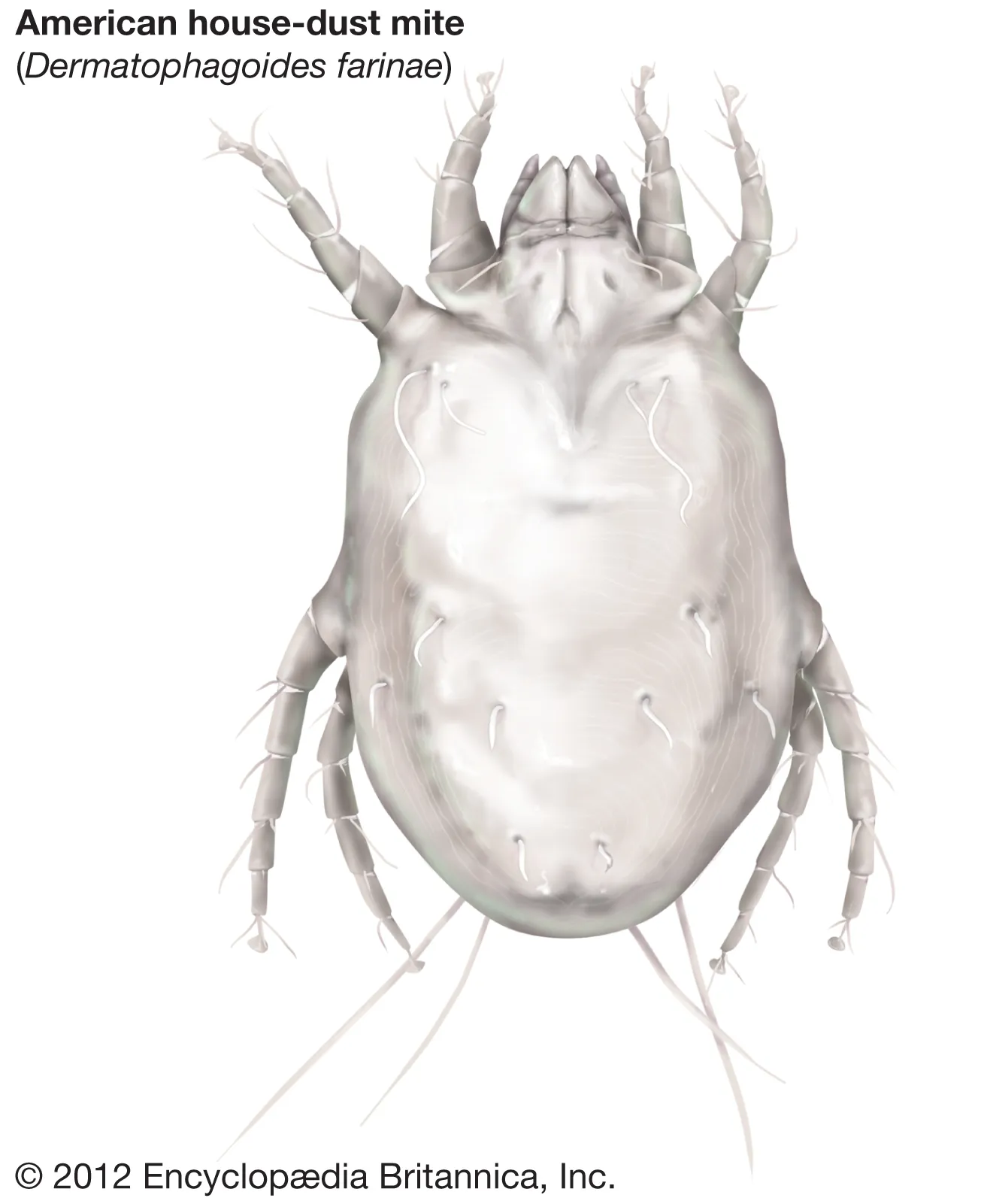
American house dust mite (Dermatophagoides farinae). Encyclopædia Britannica, Inc.
Dust mites are too small to see with your eyes alone. They are only about one-quarter to one-third of a millimeter. Under a microscope, they look like white bugs. They have eight legs and are related to spiders.1
Dust mites thrive in temperatures around 70° F and above.2 They also like humidity levels above 50%. They adapt well to the environment inside your home. They feed mainly on the tiny flakes of human skin that you shed each day. These flakes work their way deep into fabric items in your home, such as furniture, carpets, bedding (pillow and mattress), and stuffed toys.
What Are the Symptoms of Dust Mite Allergy?
Common dust mite allergy symptoms include:
- Runny nose (also known as rhinorrhea – this is typically a clear, thin nasal discharge)
- Stuffy nose (due to blockage or nasal congestion – one of the most common and troublesome symptoms)
- Sneezing
- Itchy nose, eyes, ears, and mouth
- Red and watery eyes
- Swelling around the eyes
If your dust mite allergy triggers your asthma, you may also have:
- Shortness of breath
- Cough
- Chest tightness or pain
- Wheeze (a whistling sound when you breathe)
- Waking at night due to asthma symptoms
- A drop in your peak flow meter reading (if you use one)
How Do Doctors Diagnose Dust Mite Allergy?
To diagnose a dust mite allergy, your doctor will start with taking your medical history for symptoms and do a physical exam. If your doctor thinks you may or could have a dust mite allergy, they may suggest a skin prick test or a specific IgE blood test. People who have allergy symptoms year round are often found to have indoor allergies like dust mite or cockroach.2,3
Skin Prick Test (SPT)
In prick/scratch testing, a small drop of the allergen in question is pricked or scratched on your skin. If you are allergic to the substance, you will develop redness, swelling, and itching at the test site within 20 minutes. You may also see a wheal, which is a raised, round area that looks like a hive. Wheals will itch temporarily. Usually, the larger the wheal, the more the body recognizes the allergen, though this does not always mean it causes more symptoms than something with a smaller wheal.
A positive SPT to a particular allergen alone does not necessarily mean you have an allergy. Your allergy specialist must compare the skin test results with your history, to see if the symptoms match the testing. Skin testing is done in the office and results take 15-20 minutes.
Specific IgE Blood Test
Blood tests are another way to test for allergies. These detect antibody in the blood, whereas the skin test detects local antibody already on the cell that causes an allergic reaction. Both tests tell if you make antibody to an allergen.
Blood tests can be helpful when people have a skin condition or are taking medicines that interfere with skin testing. They may also be used in children who may not tolerate skin testing.
Both blood testing and skin testing can test multiple allergens at the same time. Your doctor (or the office lab) will take a blood sample and send it to be analyzed, where allergen is added to your blood sample. This measures the amount of antibodies your blood produces, along a scale of 0.1 kilounits of antibody to >100 kilounits of antibody.
Reporting is also done in one of 6 classes, depending on how much antibody is detected. This test is called Specific IgE (sIgE) Blood Testing (most commonly as ImmunoCAP testing). As with skin testing, a positive blood test to an allergen does not necessarily mean that an allergen caused your symptoms, and your doctor has to assess this.
What Is the Treatment for Dust Mite Allergy?
Once your doctor confirms your dust mite allergy, they can help you come up with a treatment plan.
The most important step is to avoid dust mites as much as possible. Limiting your exposure to dust mites and their debris will reduce your symptoms. However, you may also need medicines to control allergy symptoms.2
Certain over-the-counter (OTC) and prescription medicines, such as antihistamines and corticosteroid [kor-tick-OH-stair-ROID] nasal sprays, may help reduce allergy symptoms. There are many allergy medicine and treatment options available to help you control your allergy symptoms. These medications treat any allergy symptoms, not just those caused by dust mite. Use AAFA’s Allergy Medicine Guide to find options. Talk with your doctor about your symptoms and which medicines are best for you. If you do not get complete relief from medicines, there are other treatment options.
If you have allergic asthma, allergy treatment will also be part of your asthma management plan. Your doctor may also prescribe anti-inflammatory medicines and quick-relief inhalers for your asthma.

How Can I Avoid Dust Mites and Prevent Allergic Reactions?
Along with treatment, managing your indoor environment is one of the best ways you can manage your dust mite allergy symptoms.
If you can’t follow every step below, remember that any effort you make to reduce dust mites can help.
Start in your bedroom. Your bedroom usually has more dust mites than anywhere else in your home. If you want to reduce your exposure to dust mites, this is the best place to start.
Take these steps to repel and remove dust mites from your bed:
- Leave your bed unmade during the day to air out.
- Vacuum your mattress every 1-3 months or more often if you do not have fully enclosed mattress allergen-barrier covers.
- Cover mattresses and pillows in zippered allergen-barrier covers. These covers are made of a material with pores too small to let dust mites and their waste product through. Some covers are also made of plastic or vinyl. Look for a Certified Asthma & Allergy Friendly® allergen-barrier mattress or pillow cover.
- Wash your sheets, blankets, and throw rugs weekly in hot water. Even if you cover your mattress and pillows, dust mites can still live in your bedding. Wash them in water that’s at least 130° F or more to kill dust mites.
- Replace your pillows every 2 years and your mattresses every 10 years. Pillows and mattresses can collect dead skin cells and dust mites and their debris over time. Use Certified pillows that can block dust mites and can hold up to regular washings.
Take these steps to reduce dust mites throughout your home:
- Get rid of all types of fabric you cannot easily wash regularly in hot water. Dust mites love wall-to-wall carpeting, curtains, fabric-covered furniture, and down-filled covers, pillows, and blankets. When possible, choose solid-surface flooring, roll-up shades, furniture not covered in fabric, and washable throw rugs.
- Reduce clutter. Dust tends to collect on clutter. Get rid of clutter as much as possible.
- Have someone without a dust mite allergy clean your bedroom. If this is not possible, wear an N95 mask when dusting or vacuuming. Dusting and vacuuming stir up dust. After cleaning, stay out of the room for at least 20 to 30 minutes.
- Use a vacuum cleaner with a HEPA filter weekly to help keep mites and mite waste from getting back into the air. But remember, vacuuming alone is not enough to remove all dust mites and their waste. A large amount of the dust mite population may remain because they live deep inside the stuffing of sofas, chairs, mattresses, pillows, and carpeting.
- Keep the humidity in your home between 30 and 50%. A dehumidifier and/or air conditioner can help with this.
- Use a Certified Asthma & Allergy Friendly® filter with your central furnace and air conditioning unit. They can help trap dust mites from your entire home. Freestanding air cleaners only filter air in a limited area. Use these in your bedroom. Avoid devices that treat air with heat, electrostatic ions, or ozone. They can pollute the air and irritate your lungs, especially if you have asthma.
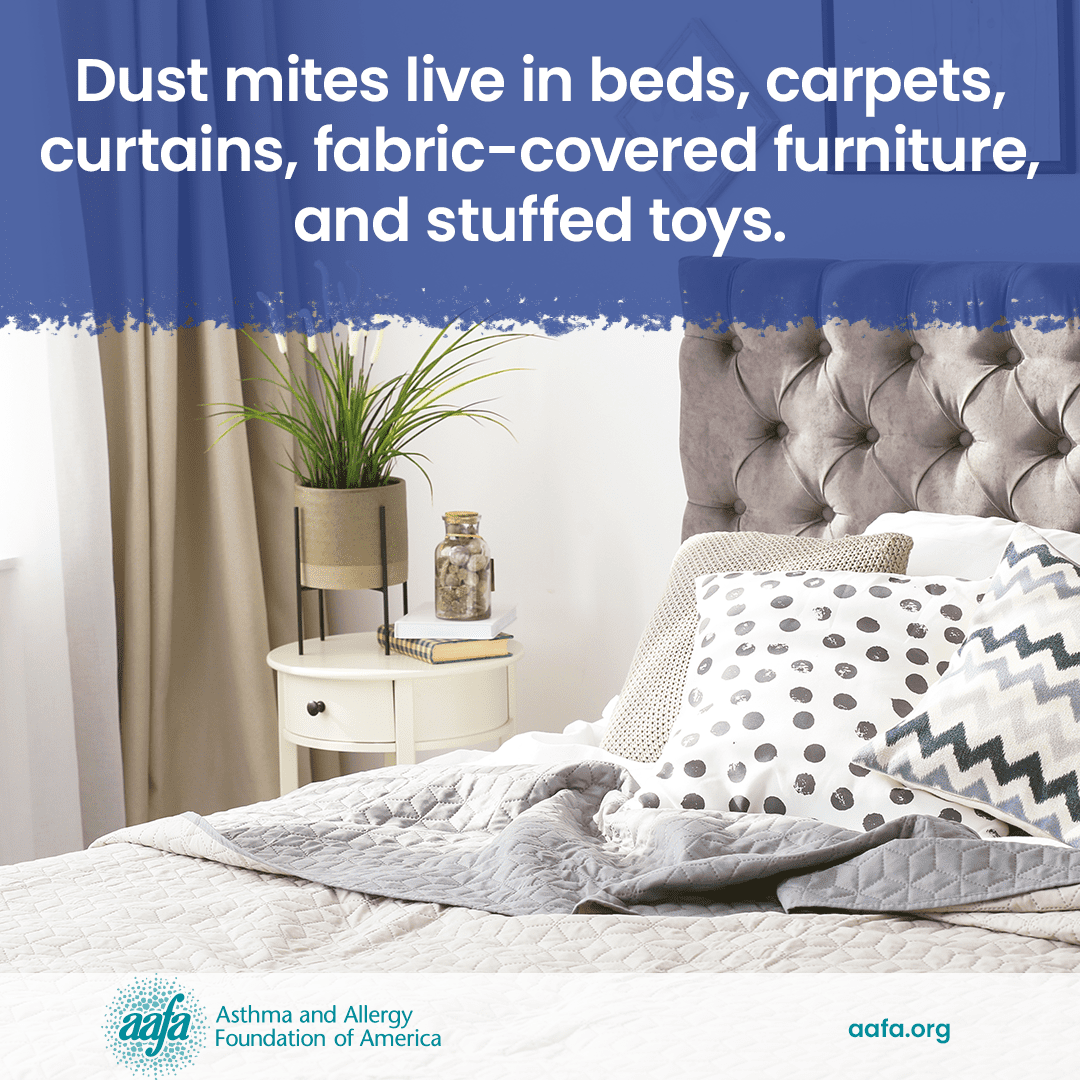
There are steps you can take to reduce dust mites in your home and improve your allergy, asthma, or eczema symptoms.
When Should I Consider Allergy Immunotherapy (Allergy Shots)?
Some people with a dust mite allergy do not get complete relief from the combination of avoidance actions and medicines. In some cases, your allergist may then consider immunotherapy [eh-mu-no-THER-ah-pee] (allergy shots).4 Immunotherapy is a long-term treatment (3-5 years) that can help prevent or reduce the severity of allergic reactions, and sometimes decrease risk of asthma triggered by allergens. It can change the course of allergic disease by reducing the body’s immune response to allergens. While many people choose to try medicines first, allergy shots or under-the-tongue tablets are also a possible first strategy.
There are two types of immunotherapy for dust mites: allergy shots and tablets.
Allergy Shots – subcutaneous immunotherapy (SCIT) has been around for more than 100 years and can provide long-lasting symptom relief. SCIT is a series of shots that have larger amounts of allergen in each shot. The allergen will be injected into the fat under the skin. Over time, allergic symptoms generally improve. Many people get complete relief within one to three years of starting SCIT. Many people also feel the benefits for at least several years after the shots stop.
Sublingual (under-the-tongue) immunotherapy (SLIT) involves placing a tablet with the allergen under your tongue for 1 to 2 minutes and then swallowing it. This treatment offers people with these allergies a potential alternative to allergy shots.
Your doctor may also customize SLIT for you using drops of dust mite extract, although this is not approved by the Food and Drug Administration (FDA) at this time.
Talk with your allergist about your allergy symptoms and your allergy treatment plan.
Medical Review July 2025 by Matthew Greenhawt, MD
Editorial Review April 2026 by Melanie Carver, Chief Mission Officer
Closed
References
- National Center for Healthy Housing. (n.d.). Dust Mites. Retrieved April 20, 2026, from https://nchh.org/information-and-evidence/learn-about-healthy-housing/health-hazards-prevention-and-solutions/dust/dust-mites/
- American College of Allergy, Asthma & Immunology. (2018, February 2). Dust Allergy | Causes, Symptoms & Treatment. Retrieved April 20, 2026, from https://acaai.org/allergies/allergic-conditions/dust-allergies/
- Aggarwal, Pearl, and S. Senthilkumaran. (2023). Dust Mite Allergy. StatPearls. www.ncbi.nlm.nih.gov/books/NBK560718/.
- Dust mite allergies: Learn More – Allergen-specific immunotherapy (desensitization) in the treatment of dust mite allergies. (2023, August 17). National Institutes of Health: National Library of Medicine; Institute for Quality and Efficiency in Health Care (IQWiG). https://www.ncbi.nlm.nih.gov/books/NBK447111/

.
Using Certified Asthma & Allergy Friendly® products in your home can help you have a healthier indoor environment, as well as reduce allergens.
To learn more about the Asthma & Allergy Friendly® Certification Program, visit: aafa.org/certified